
Intellect-Partners

Categories
Computer Science Electronics

Apple patents for FaceID for masked faces and gestures in video conferencing

The U.S. Patent and Trademark Office (USPTO) has distributed
an aggregate of 56 recently conceded licenses for Apple, including one to
adjust the organization’s device biometrics according to current conditions.

Among the reports, which were spotted by Patently Apple, is
a patent depicting mask detection abilities for Face ID, and one conceivably
empowering people to utilize communication through sign language or gestures in
video conferencing.

The main patent has been purportedly drafted by Apple to work with biometric user identification as numerous users keep on wearing face masks to restrict the spread of COVID-19.
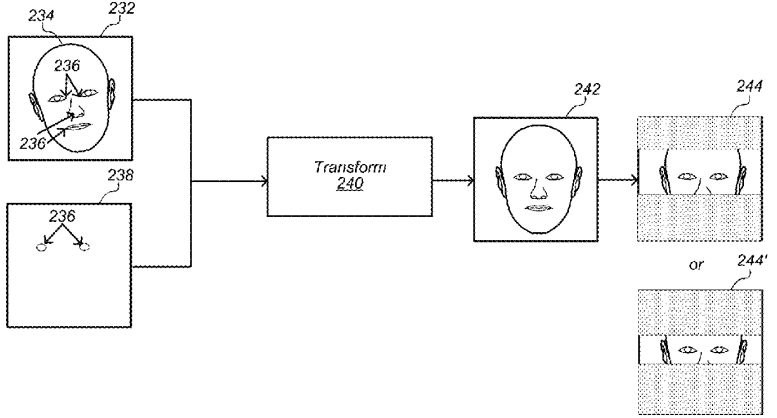
Figure from US Patent No. 11,163,981 B2

The report portrays an automated ‘switch’ between a full-face
facial recognition authentication cycle and partial face facial recognition
verification — the innovation will endeavor to attempt the full face facial
recognition authentication process when certain facial features like the eyes,
nose, and mouth, are visible, and change to partial face recognition when it
registers a portion of these facial features as at least partially impeded.

As indicated by the patent’s text, Apple is training the
incomplete face facial recognition authentication process utilizing similar
pictures as the full-face facial acknowledgment one, however, Apple added that
a portion of the pictures might be cropped for use in preparing for the latter
process.

The subsequent biometrics-related patent Apple was allowed last week alludes to ‘techniques for visual prominence of participants in a video conference.’ The document referenced applications identified with circumstances where conference participants communicate utilizing sign language or visual props.

The device would create a sign of a member’s visual
prominence in a video meeting, encode a video stream of it, and afterward
communicate it along with the visual prominence indication to a receiving
device in the video conference.
Categories
Computer Science Electronics

New Apple Glasses patent may project visuals straight onto your eyeballs

Apple has recorded a patent that determines an innovation that can project a light field straightforwardly onto a client’s pupil. The organization means to dispose of the predominant issues with AR and VR headsets with the science fiction-like innovation.

Apple is working on a way of fixing the pervasive issues with (AR) and (VR) headsets. A new patent recorded by the tech significant reveals insight into this continuous work and uncovers a fair science fiction answer for the issues – projecting the visuals directly onto your retina.

The recently recorded patent by Apple, as first spotted by Apple Insider, talks of a “direct retinal projector” that will project light field directly to the pupil of the wearer of the gadget. The innovation, prone to be a piece of Apple Glasses, later on, will likewise incorporate a “gaze tracking system” that tracks the situation of a subject’s pupil and naturally changes the projection appropriately.

The innovation will justifiably work similarly as we see objects normally from our eyes. As light reflected from the environmental factors enters the pupil, we can see the sight before us. The innovation by Apple will probably work along these lines once prepared, just the light being projected won’t be from our environmental factors however from what the AR/VR wearable is projecting.

Apple’s innovation resolves some key issues that plague the current AR and VR headsets. Instead of what the patent talks about, the current headsets use screens to project the visuals. Through the headsets, these screens are set truly near the eyes to give the illusion that the visuals are going on all around us. Though any individual who has at any point utilized a VR headset will let you know that it doesn’t work completely constantly. There are often mismatch problems with the focal lengths, making aggravations in the experience. In easier words, you will in general become mindful at certain focuses that you are wearing a headset and it is all a visual. It is likewise blurry or out of focus, frequently in such circumstances because of arrangement mismatch.

However, any individual who has at any point utilized a VR headset will let you know that it doesn’t work perfectly all the time. There are frequently mismatch problems with the central lengths, making disturbances in the experience. In more straightforward words, you will in general become mindful at certain points that you are wearing a headset and it is all a visual. It additionally goes blurry or out of focus, regularly in such circumstances because of alignment mismatch.

This mismatch creates further problems for the wearer, like eyestrain, headaches, or nausea with prolonged use. In addition, the weight of the headset is also a pain to bear after a point. Due to these reasons, AR and VR experiences are usually limited to hardly 15 to 20 minutes at one go.

This jumble makes further issues for the wearer, similar to eyestrain, cerebral pains, or sickness with delayed use. Likewise, the heaviness of the headset is additionally an agony to bear after a point. Because of these reasons, AR and VR encounters are normally restricted to barely 15 to 20 minutes at one go.

In case Apple can break the better approach for projecting such visuals, and the patent suggests that it has, it will want to change the AR and VR industry as far as we know it today. Its answer will be an exceptional, trendy innovation that will appear to be straight out of a science fiction film, and will just miss the mark regarding Elon Musk’s concept of projecting data directly into the cerebrum.

Categories
Computer Science Electronics

AMD Patent Proposes Teleportation to Make Quantum Computing More Efficient

A group of specialists with AMD have documented a patent application that looks toward a more effective and reliable quantum computing architecture, because of a conventional multi-SIMD (Single Instruction Multiple Data) approaches.

As indicated by the application, AMD is exploring a system that expects to utilize quantum teleportation to expand a quantum framework’s reliability, while at the same time reducing the number of qubits necessary for a given calculation. The point is to both alleviate scaling issues and calculation errors coming from framework instability.

There are two significant obstacles making progress toward quantum development and inevitable quantum supremacy: scalability and steadiness. Quantum states are a fickle matter, so sensitive that they can decohere at the smallest incitement – and a quantum framework’s sensitivity will in general increase with the presence of more qubits in a given framework.

The AMD patent, named “Look Ahead Teleportation for Reliable Computation in Multi-SIMD Quantum Processor,” intends to further develop quantum security, adaptability, and performance in novel, more proficient ways. It depicts a quantum engineering dependent on quantum processing regions: spaces of the chip that hold or can hold qubits, ready to pounce for their chance on the preparing pipeline. AMD’s methodology expects to enhance existing quantum models by really diminishing the number of qubits expected to perform complex estimations – through the sci-fi esque idea of quantum teleportation.

AMD’s design intends to transport qubits across districts, empowering workloads that would theoretically need all together execution to become equipped for being prepared in an out-of-order philosophy. As a quick refresher, all together execution highlights conditions between one guidance and the following, implying that responsibility must be prepared successively, with later advances reliant upon the past advance being completely handled and its outcome being known before the chip can push forward with the calculation.

As you might envision, there are chip assets (for this situation, qubits) that sit inactive until it’s their chance to play out the next computation step. Then again, Out-of-order execution analyzes a given workload, sorts out what portions of it are subject to past outcomes and which are not, and executes each step of the instruction that doesn’t need a past outcome, hence further developing execution through expanded parallelism.

AMD’s patent likewise incorporates a look-ahead processor inserted into the design, entrusted to analyze the input workload, anticipate what steps can be tackled in parallel (and those that can’t), and properly distribute the workload across qubits, utilizing a quantum teleporting technique to convey them to the necessary quantum processing, SIMD-based region.

How this quantum teleportation happens isn’t portrayed in the patent – it seems as though AMD is keeping its assets away from plain view on this one. However, it shows, without question and amaze nobody, that AMD is for sure working at quantum computing. That is by all accounts the following the next incredible computing race. And keeping in mind that AMD might be backing the right pony to ride toward an inevitable triumph it appears to be the organization intends to be a part of the race.