Intellect-Partners

Categories
Computer Science Electronics

Patent Dispute in the Supercomputing Arena: ParTec Sues Microsoft Over Azure AI Platform

The world of high-performance computing (HPC) is heating up, not just with processing power, but with a legal battle brewing between German HPC vendor ParTec and tech giant Microsoft. On June 10, 2024, ParTec filed a lawsuit in the U.S. District Court for the Eastern District of Texas, alleging that Microsoft’s Azure AI platform infringes on its patents related to a critical technology: dynamic modular system architecture (dMSA).

ParTec’s dMSA technology is a game-changer in supercomputing architecture. It revolves around tightly coupled modules housing a large number of interconnected processors or accelerators. This innovative design enables efficient handling of mixed workflows, seamlessly integrating HPC, AI, and big data analytics. According to the lawsuit, Microsoft’s Azure AI platform, touted as “one of the most powerful AI supercomputers in the world,” leverages technology covered by ParTec’s patents, granted between 2018 and 2024.

ParTec is seeking a multi-pronged resolution. The company is requesting an injunction to halt Microsoft’s use of the allegedly infringing technology within the Azure AI platform. Additionally, they are pursuing compensation for damages incurred due to the infringement and licensing fees for the use of their patented technology. The lawsuit also indicates ParTec’s preference for a jury trial.

Microsoft Azure
Microsoft Azure

Beyond the Lawsuit: Implications for the Tech Industry

This patent dispute transcends a single case. It underscores the growing significance of patent protection in the rapidly evolving landscape of supercomputing and AI development. Companies like ParTec are taking a proactive stance in enforcing their intellectual property rights, sending a clear message to tech giants like Microsoft. The onus lies on these larger players to ensure their products and services operate within the boundaries of existing patents.

This legal battle serves as a cautionary tale and a reminder to all industry participants. Staying ahead of the intellectual property curve is crucial. Companies must meticulously evaluate their technology against existing patents to avoid potential infringement lawsuits. Conversely, for those pioneering new advancements, securing robust patent protection is paramount to safeguarding their innovations and reaping the rewards of their research and development efforts.

The Takeaway: Protecting Innovation in a Competitive Landscape

The ongoing patent dispute between ParTec and Microsoft highlights the intricate world of intellectual property in the tech industry. As the boundaries of supercomputing and AI continue to be pushed, robust patent protection strategies will be instrumental for both established players and emerging innovators.

Categories
Computer Science

Demystifying Kubernetes: A Comprehensive Guide to Container Orchestration

What is Kubernetes?

Kubernetes (K8s) is an open-source platform that facilitates the execution of containerized applications in a virtual environment via Application Program Interfaces (APIs). Containerized applications are programs that are executed in containers. Containers are the virtual entities that hold the primary code for the execution of an application, its dependencies of that application and the configuration files of that application. Containerized applications are widely adapted because they facilitate the execution of multiple applications in a single host by isolating them from the core Operating System. This makes Kubernetes a go-to for users/developers to test, assess, and deploy their applications.

Kubernetes Architecture

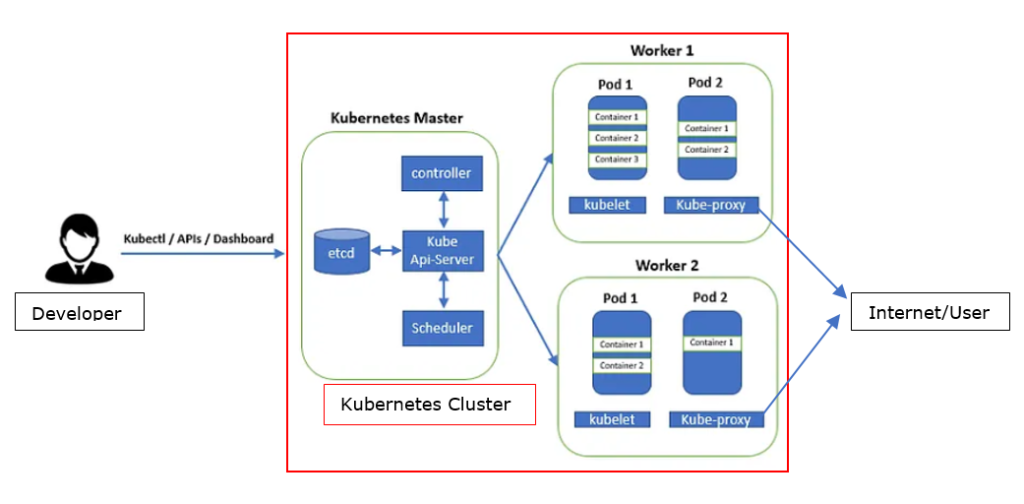
Kubernetes employs a Master-Slave architecture. Kubernetes Cluster is divided into two separate planes:

i. Control Plane: Also known as the Master Node, the Control plane can be interpreted as the brains of Kubernetes. It is the policy maker that applications executed in Kubernetes clusters have to follow. It consists of:

a. API server: The API server is the entity that authenticates and authorizes a developer and allows interaction between the developer and Kubernetes Cluster. The API server configures and manipulates entities in the data plane via Kubernetes Controller-Manager, Kubernetes Scheduler, and Key-Value Store (Etcd).
b. Kubernetes Controller-Manager: It is the entity in the Control Plane that is responsible for keeping the system in a desired state, as per the instructions obtained from the API server. It constantly monitors the containers, Pods, and Nodes and tweaks them to bring them to the desired state.
c. Kubernetes Scheduler: It is the entity in the Control plane responsible for deploying applications in Worker Nodes received through the API server. It schedules the applications as per their requirements of resources, like memory, identifies suitable Pods, and places them in suitable Worker Nodes in the Kubernetes Clusters.
d. Key-Value Store (Etcd): It is a storage that can be placed within the control plane or independent of it. Key-value Store, as the name suggests, stores all the data of the Kubernetes Cluster, i.e., it provides a restore point to the whole of the Kubernetes Cluster.

ii. Data Plane: The Data Plane is a cluster of Kubernetes Worker Nodes that executes the policies made by the Control plane for the smooth operation of applications within the Kubernetes Cluster. Worker nodes are the machines that run containerized applications and provide the necessary resources for the applications to run smoothly. Each Worker Node consists of:
a. Kubelet: Kubelet is the entity within the Worker Node that is responsible for connecting that node with the API server in the Control Plane and reporting the status of Pods and containers within the node. This facilitates the resources assigned to that node to become a part of the Kubernetes Cluster. It is also responsible for the execution of works received from the API server to keep the node in a desired state by making the necessary changes as per API server instructions.
b. Kube-proxy: It is responsible for routing traffic from the users through the Internet to the correct applications within a node by creating/altering traffic routing policies for that node.
c. Pods:  Pods are the entities in the Worker Node that have containers within them. Although it is possible to host multiple application instances in a Pod, running one application instance in one Pod is recommended. Pods are capable of horizontal scaling, i.e., they are created according to the application instance needs. If assigned node resources are available, Pods can utilize more resources than assigned to them- if needed. Pods, along with containers, are capable of running on multiple machines. The resources of the Pods are shared among the containers it hosts.

HBM Layout: Deploying an Application in Kubernetes

HBM Layout (Source: Medium)

Deploying an Application in Kubernetes:

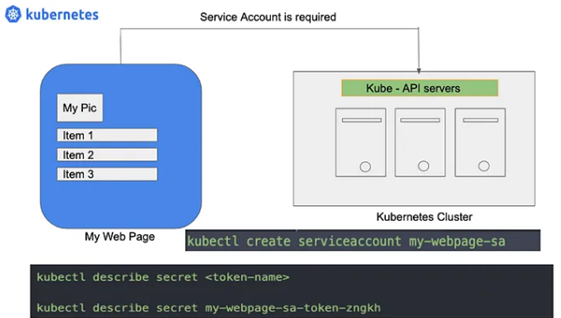
i. The developer should have a Service account. This account is needed to authenticate and authorize a developer. Also, this service account is used for authentication against the API server when the application needs access to protected resources.

Kubernetes Service Account Requirement

Service Account Requirement (Source: Medium)

ii. Create a new Node or select an existing node according to the application requirement (memory, RAM, etc).

iii. The intended application should be packed in a Docker image or similar container format. A Docker image is a software package that has all the necessary programs, dependencies, runtimes, libraries, and configuration files for an application to run smoothly.

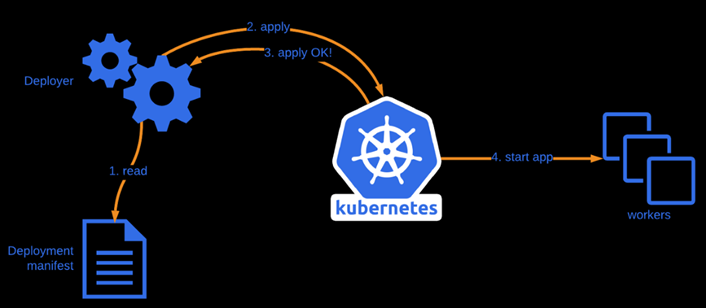
iv. The developer should define Kubernetes Manifest as a YAML or JASON file. The Kubernetes Manifest defines the desired state for the application to be deployed. It consists of:
a. Configmaps: As the name suggests, Configmaps have configuration data of the application to be deployed. It has supporting configurations, like environment variables for the intended application. The total size of this data is less than 1MB.
b. Secrets: Kubernetes secrets are similar to Configmaps, but hold secure information. They hold supporting files, like passwords, for the application that is to be deployed.
c. Deployments: Deployments define the procedure of creating and updating application instances for the application to be deployed.
d. Kubernetes Service: It is the entity that assigns an IP address or hostname to the application that is to be deployed. When the assigned name is matched to a user’s search string, the application is presented to the user through the internet via Kube Proxy.

v. The developer places the Docker image through the Kubernetes API server. The API server pulls the Docker image to create the containers in the Pods, to deploy the intended application.

vi. Once the intended application is deployed in the pods, the developer can monitor, update, change, and edit the application as per the requirement through Kubectl from the developers’ service account through the API server in the control panel.

Kubernetes Deployment Flow

Deployment Flow (Source: Polarsquad)

Categories
Automotive

LiDAR Technology in Autonomous Vehicles

Introduction:

LiDAR, an acronym for “light detection and ranging” or “laser imaging, detection, and ranging” is a sensor used for determining ranges by targeting an object or a surface with a laser and measuring the time for the reflected light to return to the receiver. With the functionality of scanning its environment, it is also sometimes called 3D laser scanning. Particularly, LiDAR image registration (LIR) is a critical task that focuses on techniques of aligning or registering lidar point cloud data with corresponding images. It involves two types of data that have different properties and may be acquired from different sensors at different times or under different conditions. With an accurate alignment of LiDAR point clouds and captured 2D images, the registration method results in the most informative understanding of the environment with fine details.

How does LiDAR work?

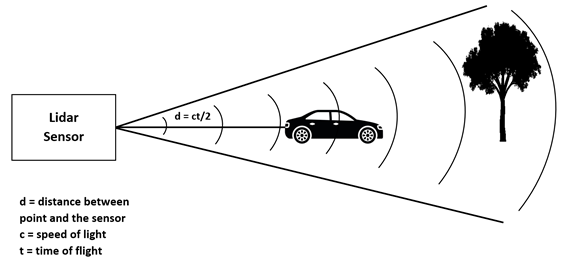
The working methodology of LiDAR includes sending a pulse of light and waiting for the return. It measures the total time period i.e. how long it takes to return the pulse. This finally assists in figuring out the distance between objects.

LiDAR Sensor Representation for Autonomous Vehicle

Fig. 1. Working of LiDAR

Application Areas of LiDAR
The fusion of LiDAR point clouds and camera images is a popular example of Multi-Remote Sensing Image Registration (MRSIR). As of today, LiDAR is of various types and forms such as static and mobile LiDARs. According to the geographical use, LiDAR is of terrestrial, aerial, and marine kinds.
The application of LiDAR is very broad. It has uses in surveying, archaeology, geology, forestry, and other fields such as:

  • Autonomous driving: LIR is used to align sensor data to create a more accurate and complete representation of the environment.
  • Robotics: Align sensor data to create more accurate maps and enable more precise localization.
  • 3D mapping: Align data from multiple sensors to create detailed 3D models of the environment.
  • Augmented Reality (AR): Synchronizing virtual elements to correspond with the physical environment.

Utilization of LiDAR in Self-Driving Vehicles

3D Point Cloud and Calculation of Distance
In the realm of road safety, numerous automobile manufacturers are either using or exploring the installation of LiDAR technology in their vehicles.

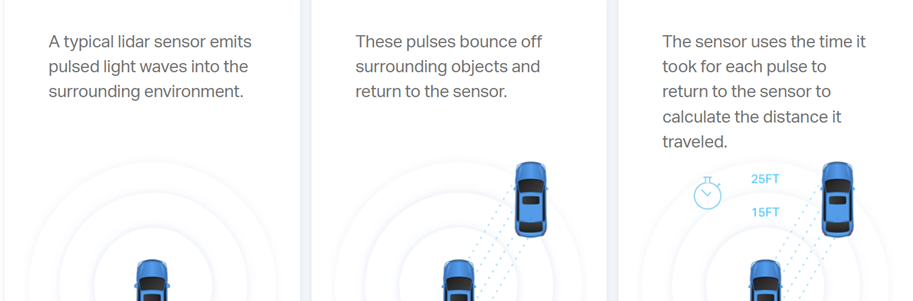
LiDAR Technology in Self-Driving Vehicles

Fig. 1. LiDAR Technology in Self-Driving Vehicles [Source: https://velodynelidar.com/what-is-lidar/#:~:text=A%20typical%20lidar%20sensor%20emits,calculate%20the%20distance%20it%20traveled]

By iterating this process multiple times within seconds, a detailed, live 3D representation of the environment is generated, referred to as a point cloud.

Advantages of Mounting Lidar Above Autonomous Vehicles
Within an autonomous vehicle, the LiDAR sensor captures extensive data through rapid analysis of numerous laser pulses. This information, forming a ‘3D point cloud‘ from laser reflections, undergoes processing by an integrated computer to generate a dynamic three-dimensional representation of the surroundings. Training the onboard AI model with meticulously annotated point cloud datasets becomes pivotal to ensuring the precise creation of this 3D environment by LiDAR. The annotated data empowers autonomous vehicles to detect, identify, and categorize objects, enhancing their ability to accurately discern traffic lanes, road signs, and moving entities, and evaluate real-time traffic scenarios through image and video annotations.
Beyond research, active exploration delves into the use of LiDAR technology within autonomous vehicles. Automakers have begun integrating LiDAR into advanced driver assistance systems (ADAS), enabling a comprehensive grasp of dynamic traffic conditions. The journey toward autonomous driving safety relies on these systems, which swiftly make precise decisions through meticulous analysis of vast data points, ensuring security through rapid computations.

Cutting-edge approaches
However, there still are challenges in developing a fully automated vehicle with a guarantee of 100% accuracy in critical tasks such as object detection and navigation. To overcome this challenge, many researchers and automobile companies have been trying to improve this technology. The cutting-edge approaches include broadly categorized architecture of methodologies involving four distinct pipelines: information-based pipeline, feature-based pipeline, ego-motion-based pipeline, and deep learning-based pipeline. There has been more accuracy and improvement in the sector of deep learning-based pipelines. LiDAR technology not only enhances convenience but also plays a pivotal role in reducing severe collisions. The latest advancements in this domain include the innovation of LiDAR sensors and the shift from traditional mechanical methods to cutting-edge FMCW and flash technologies.

Patenting Trends for LiDAR Technology in Autonomous Vehicles

The field of autonomous vehicle technology has witnessed a notable rise in patent submissions, especially concerning sensor technology, mapping techniques, decision-making algorithms, and communication systems. Pioneering the advancements are entities such as Google, Tesla, and Uber, whereas longstanding automotive giants like Ford, General Motors, and BMW have also been actively filing patents. In the United States, a significant emphasis lies on artificial intelligence (AI) and augmented reality within the market, with car manufacturers and developers collaborating to introduce self-driving vehicles to the public. Autonomous cars are predicted to change the driving experience and introduce a whole new set of problems.
Despite Sartre’s initial patent submission in the autonomous vehicle domain, it was perceived primarily as a patent related to an AI system designed for highway navigation or restricted roadways. There was a scarcity of US patent filings for self-driving cars before 2006, largely influenced by a trend that emerged in the late 1990s and persists today: a limited number of patents granted by the US Patent Office.

Challenges in Patenting Technology for Autonomous Vehicles
The challenges in patenting technology for self-driving vehicles emerge when these vehicles are involved in incidents or insurance-related events. Owners typically confront three choices:

  1. Assuming liability for any harm or property damage caused by their vehicle.
  2. Taking steps toward legal recourse against the involved driver.
  3. Exploring compensation from their insurance company to address losses resulting from the other driver’s negligence.
    However, legislative uncertainty still clouds the landscape concerning autonomous vehicles and traffic incidents.

Analysis of Patent Applications filed under Lidar in Autonomous Vehicles
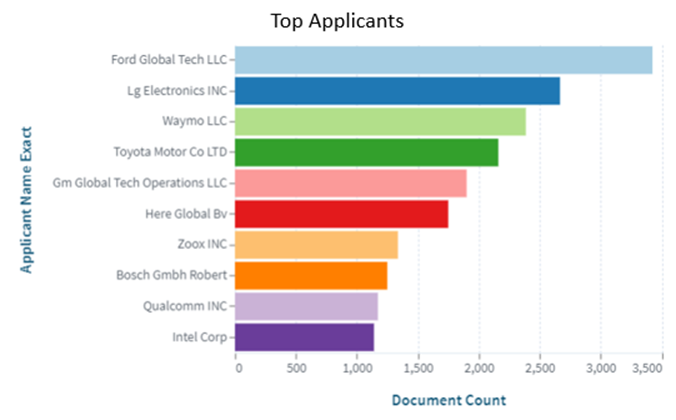
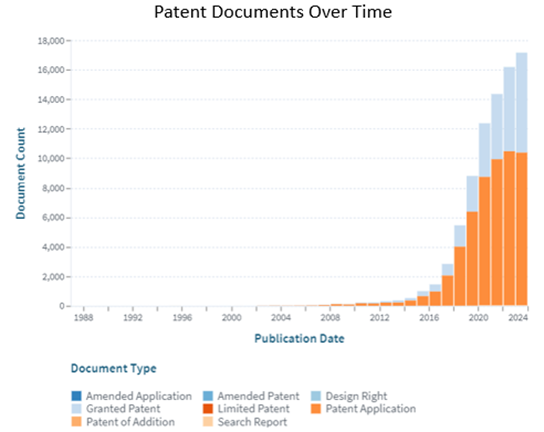
Over the past few years, there has been a rapid growth in filing Patent Applications regarding the use of LiDAR in Autonomous Vehicles. As of today, it is marked that there are ~81,697 patents recorded around the globe. It has been observed that Ford Global Tech LLC with ~3,426 patents is a dominant player in the market. Similarly, LG Electronics and Waymo LLC stand in second and third position in the chart.

Analysis of Patent Applications filed under Lidar in Autonomous Vehicles

[Source: https://www.lens.org/lens/search/patent/list?q=LiDAR%20%20%2B%20Autonomous%20vehicle]
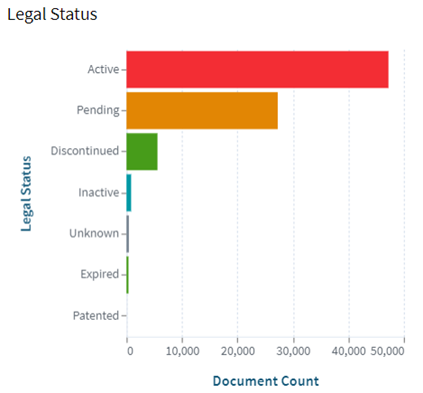
The following visual representations show the charts representing Legal Status and Patent Documents Over Time.

Legal Status and Patent Documents Over Time.
Patent Documents Over Time

[Source: https://www.lens.org/lens/search/patent/list?q=LiDAR%20%20%2B%20Autonomous%20vehicle]

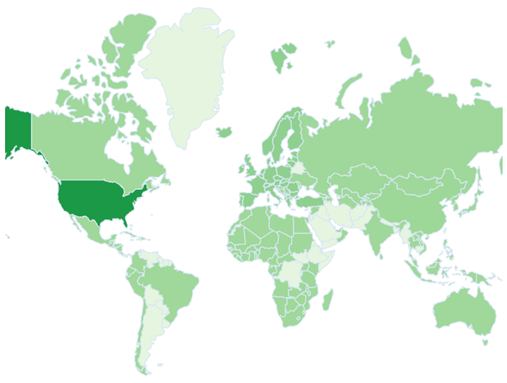
Through an examination of patent filings across different geographic regions, it is evident that the United States, constituting approximately 78% of the overall patents submitted, holds the foremost position in this chart.

patent filings across different geographic regions

[Source: https://www.lens.org/lens/search/patent/list?q=LiDAR%20%20%2B%20Autonomous%20vehicle]

Conclusion

In conclusion, LiDAR technology used in self-driving vehicles has a huge scope in improving road safety. With the cutting-edge FMCW and flash technologies, the application of LiDAR in autonomous vehicles shows great improvements in terms of accuracy and comfort providing features like object detection and incredible navigation. Automobile companies such as Tesla and Toyota have already practiced the technology in their vehicles and companies having such huge turnovers are seeking forward to utilize the full potential of the technology. Technology holds the future of global advancement in technology.