
In a time when climate changes are becoming more unpredictable and water shortages are affecting many people, science is looking up at the sky for answers. One technique that has been both celebrated as a great scientific achievement and questioned as humans tampering with nature is called cloud seeding. But what is cloud seeding, how does it function, and why is it seen as both promising and controversial?
What is Cloud Seeding?
Cloud seeding is a way to change the weather by putting certain materials into the air. These materials help create tiny particles that water vapor can stick to, which then form raindrops or snowflakes. In simple words, cloud seeding is like adding seeds to a cloud to help it produce rain.
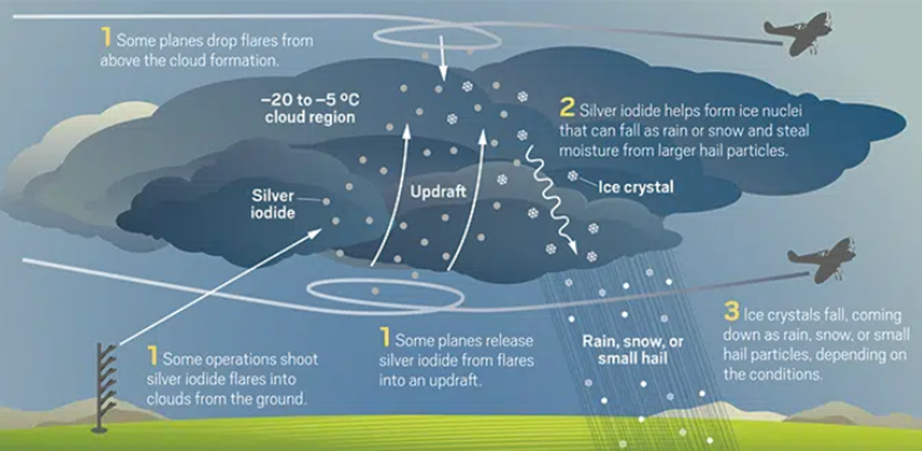
Source: https://earth.org/unleashing-the-power-of-cloud-seeding-navigating-potential-and-pitfalls/
How Does It Work? How Does It Work?
Clouds are composed of tiny water droplets or ice crystals that float in the atmosphere. These droplets remain suspended because they are too small to fall. For rainfall to occur, these droplets need to combine into larger droplets or ice crystals that are heavy enough to overcome air resistance and fall to the ground.
Cloud seeding accelerates this natural process by:
- Injecting particles (such as silver iodide, potassium iodide, or dry ice) into the atmosphere.
- These particles provide surfaces on which moisture in the cloud can condense or freeze.
- As water droplets or ice crystals grow larger, they fall under gravity, producing rain or snow.
Depending on the atmospheric conditions, cloud seeding can aim for:
- Cold cloud seeding: Uses ice-nucleating agents (e.g., silver iodide) to stimulate ice crystal growth.
- Warm cloud seeding: Uses hygroscopic particles (e.g., sodium chloride) to encourage droplet coalescence.
Cloud seeding can be done by aircraft, rockets, or ground-based generators that disperse the seeding material into suitable clouds.
A Brief History of Cloud Seeding
Altering the weather is not a new idea. People of ancient cultures performed rituals and dances in order to influence divine will to create rain. Yet it was not until the 20th century that scientists began their serious project of altering the weather.
1940s – The Beginning
Cloud seeding had its official start in 1946, when Vincent Schaefer, researching at the General Electric Research Laboratory in New York, discovered that introducing dry ice into the supercooled cloud could generate snow. Coupled with Bernard Vonnegut’s discovery that silver iodide could cause a similar reaction, this work started modern cloud seeding.
1950s–1970s – Military and Research Use
- The U.S. military experimented with weather modification during the Vietnam War under Project Popeye, using cloud seeding to extend the monsoon season and hinder enemy supply routes.
- In the same period, Project Stormfury attempted to weaken hurricanes by seeding their outer bands, though with limited success.
1980s–2000s – Expansion and Commercialization
- Countries like China, Russia, India, Australia, and the United Arab Emirates (UAE) began experimenting with or adopting cloud seeding as part of drought mitigation strategies.
- China famously used cloud seeding to clear pollution and ensure dry weather during the 2008 Beijing Olympics.
Recent Developments
- The UAE has invested heavily in advanced cloud seeding technologies, including unmanned aerial vehicles (UAVs).
- In 2021, researchers explored using electric drones to shoot charged particles into clouds to enhance rain formation—a more eco-friendly alternative to chemical seeding.

Patent Landscape and Graphical Exploration
Top Applicants
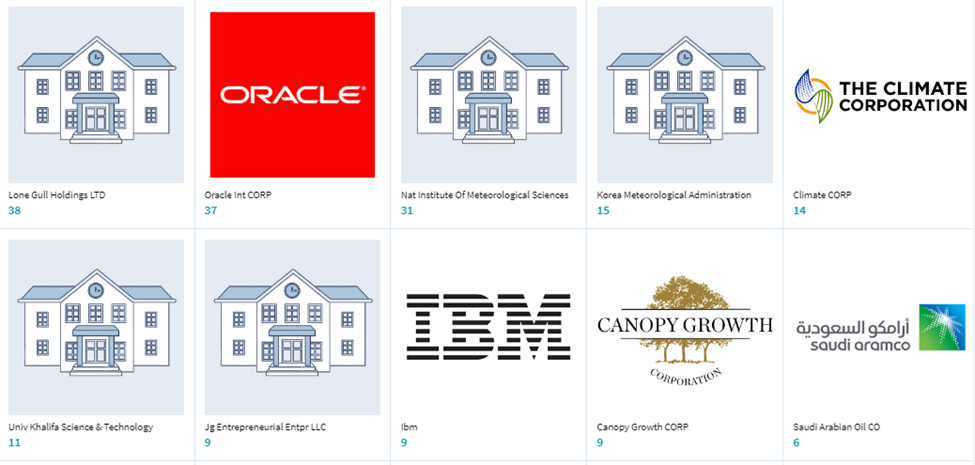
Cloud Seeding Top Applicants (Source: https://www.lens.org/)
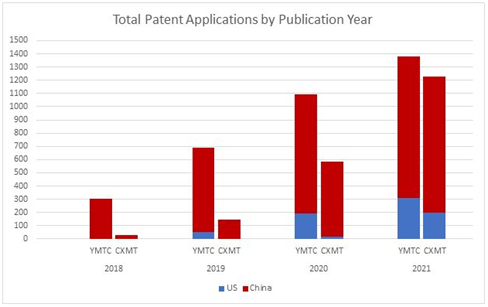
Patent Documents Over Time
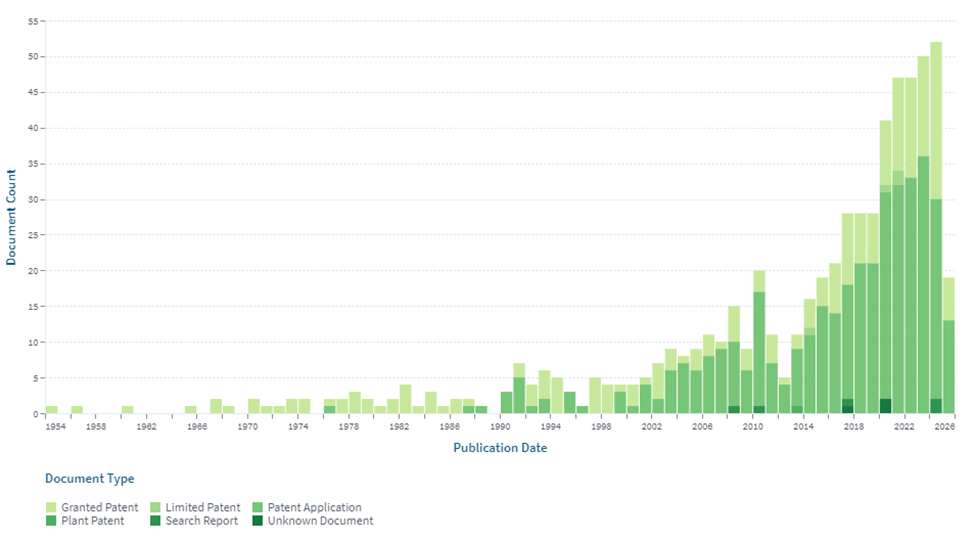
Cloud seeding Patent Documents Over Time (Source: https://www.lens.org/)
U.S. Leading the Patent Charge

Cloud Seeding Patent documents by Jurisdiction (Source: https://www.lens.org/)
Top CPC Classification Codes
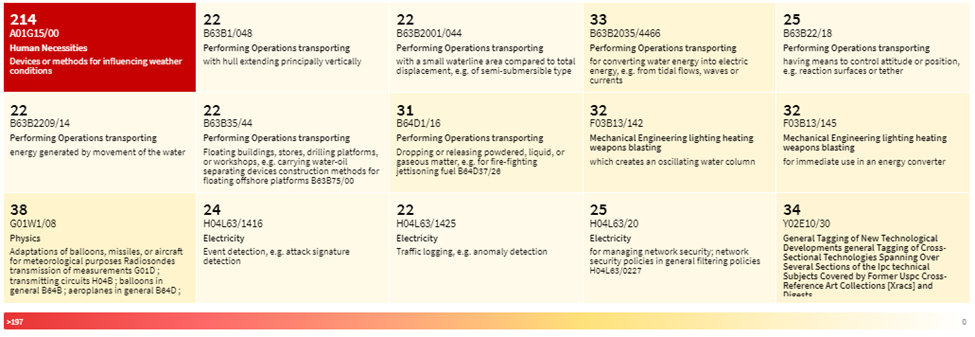
Cloud seeding Top CPC Classification Codes (Source: https://www.lens.org/)
Top IPCR Classification Codes
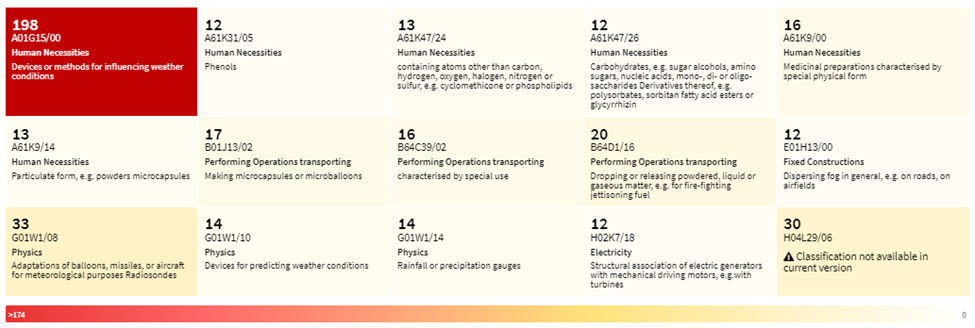
Cloud Seeding Top IPCR Classification Codes (Source: https://www.lens.org/)
CLOUD SEEDING MARKET TRENDS
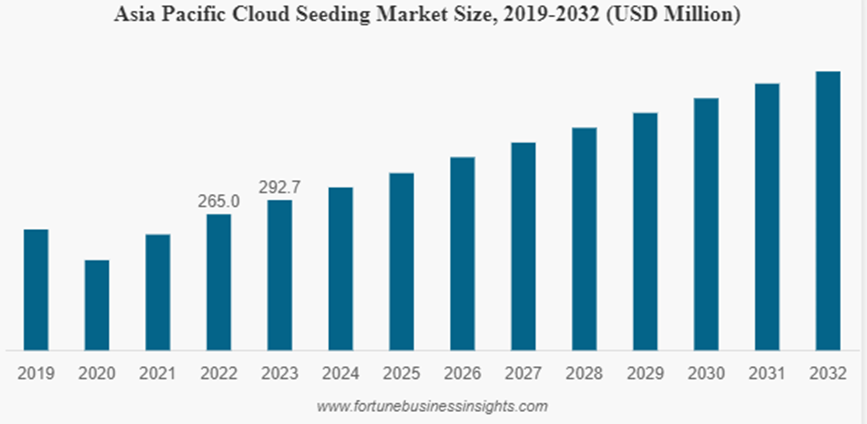
The size of the global Cloud Seeding market is USD 375.6 million in 2023 and is anticipated to grow from USD 406.4 million in 2024 to USD 684.2 million by 2032, with a CAGR of 6.7% during the forecast period. In 2023, Asia Pacific had a 77.93% cloud seeding market share.
In the market, many trends will develop in the area of technological advancement and new product innovations. Leading companies in the market will develop new technologies to make the process of artificial rain as cheap and environmentally friendly as possible. This involves focusing on advanced seeding agents and minimizing the process’s upfront and operations costs. For example, An UAE-backed study proposes that the use of drones could improve the effectiveness of artificial rain. The study shows that the use of drones could identify specific spots in the clouds for seeding, using an unmanned aircraft system (UAS) to enhance the ability to stimulate more rainfall.
This identification process facilitates a more targeted weather modification method. Normally, NCM (the National Centre of Meteorology of the UAE) uses piloted planes to create artificial rain. However, drones are seen as a consideration to optimize the efficacy of the program.
CLOUD SEEDING MARKET GROWTH FACTORS
Climate change has increased the frequency of extreme weather events, hurricanes, prolonged droughts, extreme heat, and changing precipitation patterns. Various governments and industries are looking for solutions to manage and work through water resources and climate change related anomalies. With a growing need for reliable water sources water all around the world, interests in artificial rain have increased; this is just one of the many solutions to consider.
Below is a list of climate anomalies in the U.S. for the fiscal year 2022 according to NOAA (The National Oceanic and Atmospheric Administration): The annual precipitation for U.S. was 28.35 inches, which was 1.59 inches below average and was classified in the driest third of the historic record. In 2022, there were 18 separate billion-dollar weather and climate disasters, which was the third most for disasters and the third richest year, (43 years). Between April and June, the Hermits Peak Fire, created a new record for New Mexico for the largest wildfire comprising over 341,000 acres. In 2022, in the U.S. approximately 66,000 fires that burned about 7.5 million acres, which is close to the annual average.
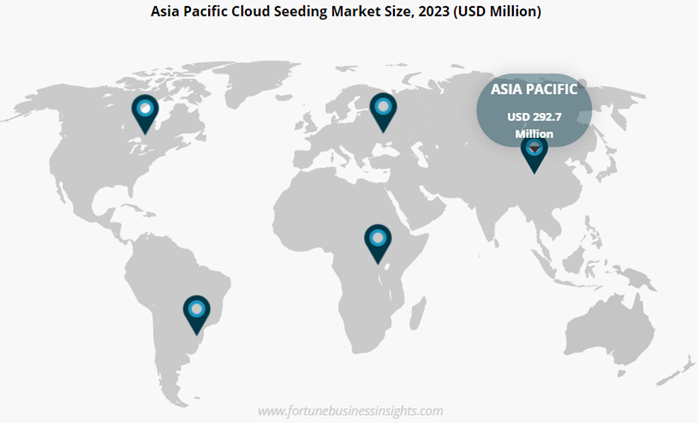
Source: https://www.fortunebusinessinsights.com/cloud-seeding-market-104073