

Intellect-Partners

Categories
Automotive Mechanical

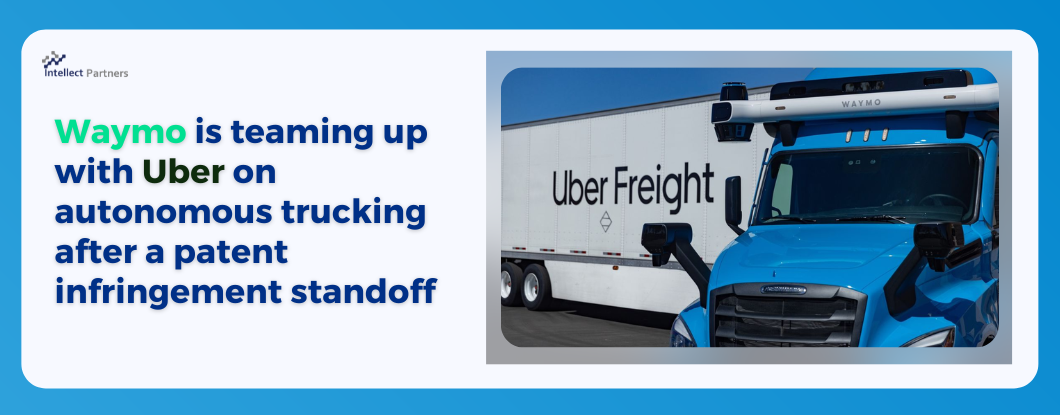
Waymo is teaming up with Uber on autonomous trucking after a patent infringement standoff

Waymo and Uber, previous legal foes and harsh opponents in the autonomous vehicle space, are collaborating to accelerate the adoption of driverless trucks. Waymo is incorporating Uber Freight, the ride-hail organization’s truck business, into the innovation that powers its autonomous big rigs.

This “long-term strategic partnership” will enable fleet owners to more rapidly send trucks equipped with Waymo’s autonomous “driver” for on-demand delivery courses presented by Uber Freight, the organizations said.

The declaration addresses a union between two of the organizations’ significant side projects. Waymo separates its autonomous projects into two divisions: Waymo One, its consumer ride-hailing service, and Waymo Via, which is centered around goods delivery in both trucking and local delivery formats. Uber Freight, which was launched in 2017, connects drivers with shippers, much similar to the organization’s ride-hailing application that matches drivers with those searching for a ride.

Waymo depicts the collaboration as a “deep integration” of each organization’s products, including a mutually developed “product roadmap” to outline how autonomous trucks will get conveyed to Uber’s organization once they are commercially ready. Up to that point, Waymo says it will utilize Uber Freight with its test fleet to better comprehend how driverless trucks will receive and accept delivery orders.

Yet, the partnership goes past beta testing each other’s innovation. Waymo said it will save “billions of miles of its goods-only capacity for the Uber Freight network” in a capacity commitment intended to highlight the seriousness of this partnership.

In the not-so-distant past Waymo and Uber were in a grueling standoff over the eventual fate of autonomous vehicles. In February 2017, the Alphabet-owned organization sued Uber and its auxiliary, self-driving truck startup, Otto, over charges of trade secret theft and patent infringement. Waymo looked for $1.4 billion and a public apology from Uber, however, the ride-hail organization dismissed it as a non-starter.

The case went to trial for almost a year, however, finished quickly when the two sides reached an unexpected settlement agreement. Uber later conceded that it misappropriated a portion of Waymo’s tech and promised to permit it for future use. Anthony Levandowski, a previous Google engineer and the organizer behind Otto, was sentenced to 18 months in jail for taking Waymo’s trade secrets however was subsequently pardoned by former President Donald Trump.

There is no notice of past indiscretions in the declaration. Uber had been developing its self-driving truck as a feature of its bigger interest in autonomous innovation however later off-stacked it to Aurora, a startup established by the previous head of Waymo when it was only Google’s self-driving vehicle project. Expanding costs, in addition to the misfortune in Arizona when an Uber self-driving vehicle struck and killed a passerby, constrained Uber to take back its AV project.

Waymo has made a flurry of arrangements lately pointed toward developing its nascent trucking business. The Google spinoff has said it has no plans to possess or work its fleet of trucks and on second thought will work with truck manufacturers, carriers, and representatives to coordinate its innovation into the business of hauling freight.

Categories
Computer Science Electronics

Sound View Innovations, LLC files another infringement suit against Hulu, LLC

Hulu LLC will again need to confront infringement claims for
a part of Sound View Innovations LLC’s presently expired patent after the
Federal Circuit sent the suit back to the district court for another look.

A California federal court was wrong in concluding that the term “buffer” in the patent case can’t cover a “cache,” the U.S. Court of Appeals for the Federal Circuit ruled in a precedential assessment.

However the Federal Circuit agreed with the U.S. District Court for the Central District of California’s case development in a patent covering methods for streaming media data over public networks, it told the lower court to revisit its utilization of the terms like “buffer” and “cache,” resuscitating a chapter in the long-running question among Hulu and Sound View Innovations.

Sound View Innovations sued Hulu in 2017 for infringing six licenses with Hulu’s web-based video-on-request products. A portion of the issues including one more patent grabbed the eye of the U.S. Patent and Trademark Office administration. Just this dispute, including U.S. Patent No. 6,708,213, remained at the Federal Circuit.

Hulu and Sound View Innovations fought at the California court over the significance of a downloading limit in one of the patent’s cases. The region judge sided with Hulu, finding that the case should allude to just a single buffer as opposed to including multiple. Hulu could not have infringed the patent since Sound View’s servers don’t download and retrieve data in the same buffer.

The Federal Circuit decided that the district’s court claim development was right in expecting that the downloading and retrieving acts need to include a similar buffer. Caches, however, which Sound View Innovations depended on for its infringement allegation, could likewise be buffers, the Federal Circuit found. Despite the lower court’s decision, the expressions “do not appear to be mutually exclusive, but instead seem to have at least some overlap in their coverage” in the patent.

Categories
Computer Science Electronics

PayPal, Apple Pay Accused of Patent Infringement by Fintiv

Mobile payments and commerce platform Fintiv has hit PayPal and Apple Pay with a claim on charges of patent infringement. Fintiv documented a comparative claim against Walmart as well.

Fintiv blamed PayPal for infringing five of its licenses connected with payments functionality, as per court reports. The suit Fintiv brought against Walmart charges that proprietary secrets were utilized improperly. The claim additionally charges that the retail goliath infringed a similar installment patent as PayPal, explicitly, utilizing phone innovation to process payments.

“These three cases are pretty significant for the tech community as a whole,” says Court Coursey, a director with Fintiv. “If you see one of these cases become a victory, I think you’ll see the rest become license deals pretty quickly.”

The complaint against PayPal was documented recently and looks for harms, sovereignties, and related court and legal expenses, plus interest.

“We’re talking billions of dollars here,” Sol Saad, a Florida tech investment banker, told in certain reports. His firms have advised Fintiv in the past. “This would include future royalties but also back payments for prior years of infringement.”

“Fintiv has a strong patent portfolio of over 150 patents, in addition to a large number of patent continuations and patents pending,” Saad told in reports. He explained that Mozido, Fintiv’s predecessor company, invented and patented the ideas necessary to create the mobile payments before the technology to power those ideas had been developed and has followed up with subsequent patents as the technology to support them emerged.

Mozido, Fintiv’s ancestor organization, established a phone-based payment settlement business with Western Union and Radio Shack in early 2008.

Fintiv at first hit Apple with a claim in December 2018. In October 2019, Apple documented a request to take a gander at the licenses. Apple was denied the patent review in May 2020. A trial was initially set for March 2021.

Presently the trial is planned for June in United States District Court for the Western District of Texas in June 2022.