
Intellect-Partners

Categories
Computer Science

Zero Trust Security: Why Traditional Firewalls Aren’t Enough

Introduction

With the quickly changing digital age, cybersecurity is now a top priority for organizations, governments, and individuals. Old security architectures that focus on perimeter defenses like firewalls are being left behind by the sophistication and magnitude of contemporary cyber threats. As organizations adopt cloud computing, remote work, and deploy Internet of Things (IoT) devices, the perimeter of a secure network is increasingly fuzzy. This new paradigm has spawned a new model of cybersecurity.

Zero Trust Security

The Legacy of Classic Firewalls

Fundamentally, a firewall is a software barrier that screens traffic through pre-programmed rules, separating what’s considered secure from what isn’t. Classically, firewalls have worked on the axiom that anything within a network can be trusted, and anything outside of it is potentially dangerous. This model was the foundation of enterprise security for many years.

The perimeter-based security architecture, though, was intended for a world in which everything users, applications, and data all sat behind an internal network. Employees typed away from office desktops, and sensitive data sat on on-premise servers. With these conditions, controlling access at the perimeter made sense. But the digital landscape has changed, rendering this model outdated and vulnerable.

The Limitations of Traditional Firewalls

The biggest failing of old firewalls is that it has in fact, eaten away at the network perimeter. The world has become cloud friendly, and is more inclined towards remote working with frequent access to the corporate resources from outside the office on personal devices or unsecured networks. Firewalls have minimal visibility or control over this activity. Therefore, attackers no longer must pierce strong network perimeters they just log in.

In addition, conventional firewalls are based on a model of implicit trust. Once a user or device gains once it enters the network, it is generally given wide access to internal systems and data. This creates an environment in which a single compromised endpoint can result in a catastrophic breach. Cyber attackers use this to their advantage by hijacking stolen credentials or malware to move laterally throughout the network, accessing sensitive information without popping up immediate red flags.

Another key problem is that firewalls are not cloud-native. Contemporary organizations tend to employ a hybrid of public cloud services, private data centers, and SaaS platforms. Firewalls, which were made for static environments, cannot enforce security policies uniformly in such dynamic infrastructures. Their rules and configurations are manually managed and hence are hard to scale and adapt in real-time.

What Is Zero Trust Security?

Zero Trust is an information technology framework based on the ideology of “never trust, always verify.” Unlike legacy models that trust that internal networks are secure, Zero Trust views every access request, whether it comes from within or without the organization, as suspicious. Access is
only permitted after rigorous identity authentication, device confirmation, and contextual risk evaluation.

In a Zero Trust architecture, least privilege access is a fundamental tenet. Users and devices are granted only the privileges they require to execute a particular set of tasks, nothing additional. This severely minimizes the attack surface and culls the potential impact if a credential is breached.

Micro-segmentation is another main characteristic of Zero Trust. Rather than depending on a solitary, integrated network, organizations segment their infrastructure into silos. Even should an attacker manage to get access into one segment of the system, they cannot easily move over to others. This resource compartmentalization achieves an additional layer of defence and constrains lateral movement.

Core Pillars of Zero Trust

A Zero Trust build consists of a number of inter-dependent elements:

  • Identity and Access Management (IAM): Verifies that only authenticated and approved users to access systems, usually with Multi-Factor Authentication (MFA) and Single Sign-On (SSO) for enhanced security.
  • Continuous Monitoring and Analytics: Zero Trust is not about static trust. The system continuously monitors user behaviour, location, device posture, and network activity to identify anomalies.
  • Device Trust: Not only is access granted based on user identity but also on the trustiness of the device. Is it patched? Is it in compliance with corporate policies?
  • Application and Data Security: Policies enforce secure access at the application layer, ensuring that users only interact with what’s required. Sensitive data is safeguarded through encryption, logging, and monitoring.
  • Zero Trust Network Access (ZTNA): ZTNA supplants traditional VPN solutions by linking users directly to particular applications instead of entire networks, thus reducing exposure.
Why Zero Trust Beats Firewalls

The contrast between Zero Trust and conventional firewalls isn’t philosophical it’s pragmatic.

Zero Trust presumes breach. It works with the expectation that attackers might already be within the network and constructs defences based on this expectation. Conventional firewalls are, on the other hand, reactive and concentrate on keeping threats external, too frequently neglecting what occurs once the perimeter is compromised.

Take the case of an attacker using a phishing attack to obtain valid user credentials. In the typical firewall-based setup, such an attacker would be able to penetrate the network and start exfiltrating information with minimal resistance. The firewall would not notice this internal traffic as malicious. But in a Zero Trust setup, the login attempt would initiate further verification processes. If the access is from an unexpected place or device, it might be blocked entirely. Even if the attacker successfully logs in, they would only have access to a thin slice of resources, and anomalous behaviour would most likely be picked up by analytics tools for rapid action.

Zero Trust in a Cloud-First World

The move towards cloud-native technologies and hybrid workspaces has made Zero Trust not only pertinent but necessary. Companies today are running on numerous cloud environments, SaaS offerings, and distributed teams geographically. Within these setups, the classical concept of “inside the network” is no longer applicable.

Zero Trust naturally belongs to this paradigm by taking security past the perimeter. It gives identity-based access control for all applications, services, and infrastructure irrespective of location. Whether a user is accessing from a corporate laptop in the office or a smartphone at home, their identity and behavior need to be authenticated prior to access.

Challenges of Implementing Zero Trust

Although it has its benefits, putting into practice Zero Trust is no cakewalk. For most organizations, it is a painstaking and resource-hungry process to move away from legacy systems. Identifying all applications, devices, users, and data flow across an organization is a serious task and is essential to effective Zero Trust adoption.

There is also a cultural side. Moving to Zero Trust can bring more restrictive access controls and increased authentication, which will likely meet opposition from users who are used to imperceptible access. With the right communications, training, and user experience design, though, these obstacles can be overcome.

In addition, vendors all don’t define Zero Trust similarly. Companies have diverse options for tools and platforms and need to exercise care in choosing them to verify they are aligned with real Zero Trust practices instead of marketing hype.

Conclusion:

Adopting the Cybersecurity Future
Historical firewalls were the initial defense line in a time when information was centralized, users were static, and threats were comparatively unsophisticated. But in today’s hyper-connected, decentralized digital space, these defenses are insufficient. The trust-based perimeter security model is inherently defective in a world where attacks can come from anywhere externally or internally.

Zero Trust Security provides a revolutionary strategy for this new world. By constantly verifying identity, implementing least privilege, and inspecting all attempts at access, organizations can construct strong, adaptive, and proactive security designs. Zero Trust is not a fad it’s a strategic imperative for any organization hoping to survive in the midst of today’s cyberattacks.

As cyberattacks increase in sophistication and the attack surface keeps growing, only those who trust no one and validate everything will stay safe.
Categories
Electronics

When Seeing Isn’t Believing: The Deepfake Dilemma

What if you couldn’t trust your own eyes or ears?

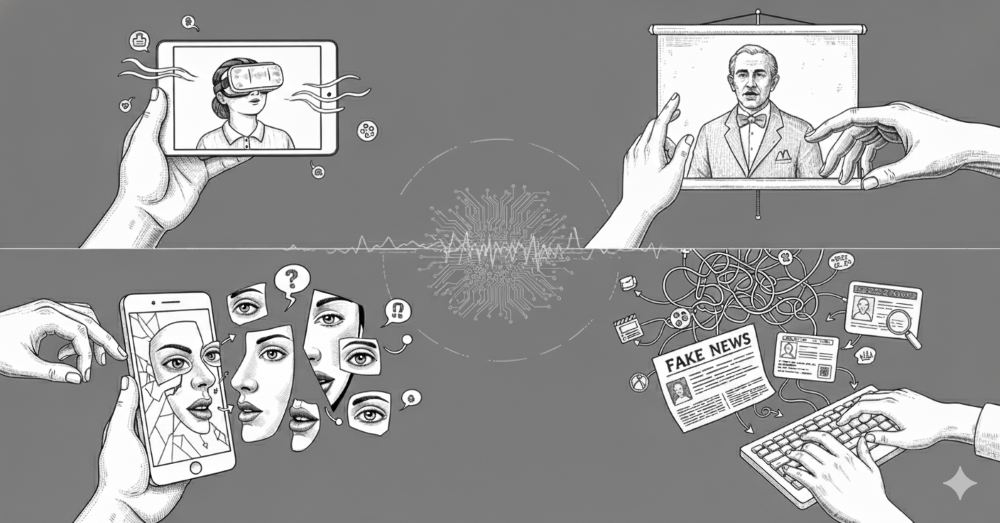
Welcome to the deepfake era, where artificial intelligence doesn’t just predict the future—it recreates the present. With a few lines of code and enough data, machines can now craft shockingly realistic videos, voices, and digital personas that mimic reality with near-perfect precision. It’s dazzling, it’s dangerous, and it’s blurring the line between fact and fabrication faster than we can blink.

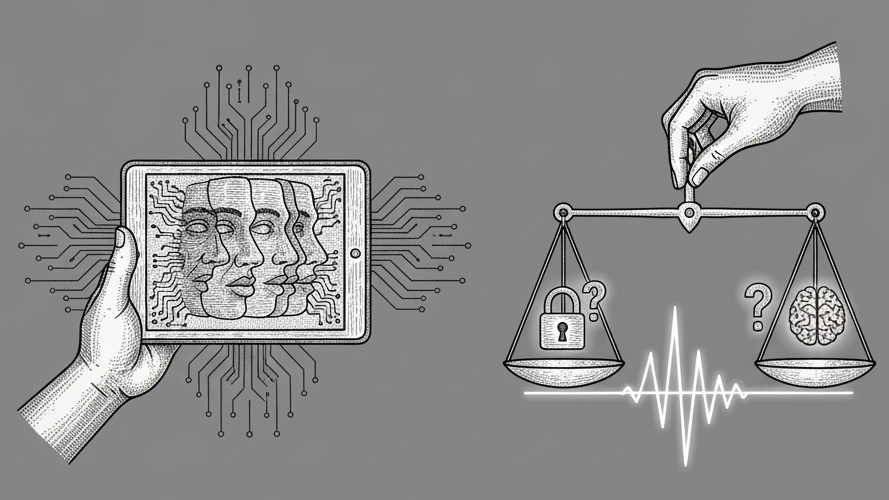
But behind the digital magic lies a growing storm: challenges in detecting these fakes, protecting personal identities, and untangling the legal chaos of who owns what in this synthetic frontier. As generative AI races ahead, we’re not just facing a technological revolution. We’re staring down a truth crisis.

Deepfakes Demystified: When AI Plays Pretend

Deepfakes are artificial intelligence (AI)-generated or modified digital content that realistically imitates actual persons, events, or behaviours. These are mostly deep learning models. Deepfakes typically entail the manipulation of both audio and video. For example, someone may synthesise sounds of a politician saying something they have never said or replace the visage of a celebrity with their own.

Building the Illusion: How Deepfakes Are Made

Advanced machine learning methods, including Generative Adversarial Networks (GANs), Variational Autoencoders (VAEs), and more recently, diffusion models, are used in the creation of deepfakes.

GANs Unleashed: The Engine Behind Deepfakes

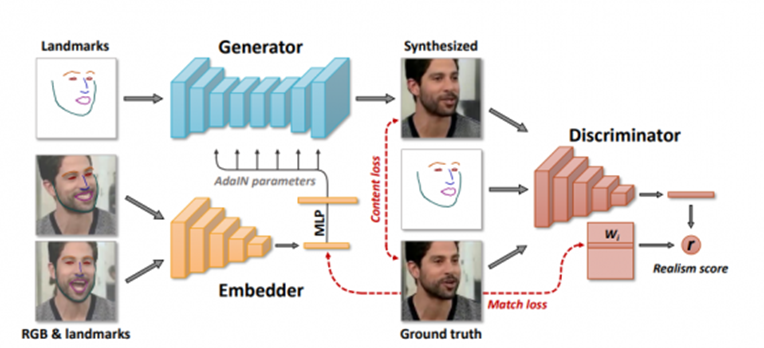
GANs operate through a competitive process between two neural networks:

• Generator: Tries to produce fake data that imitate real media.

• Discriminator: Attempts to distinguish real data from generated fakes.

The discriminator improves its capacity to spot differences as training goes on, while the generator becomes better at producing content that looks legitimate. The generator eventually creates hyper-realistic media with outputs that deceive even highly skilled discriminators.

Figure 1: GAN architecture (https://neurohive.io/en/news/deepfake-videos-gan-sythesizes-a-video-from-a-single-photo/)

The Art of Deception: Deepfake Methods in Action

  • Face Swapping: Replacing one person’s face in a video or image with another’s.
  • Facial Reenactment: Mapping a person’s facial expressions onto another’s face in a video, making them appear to say or emote things they never have.
  • Talking Faces: Generating mouth and face movements that precisely sync with arbitrary speech audio.
  • Voice Cloning: Mimicking a person’s voice using small audio samples and generating new speech.

Large datasets of photos, films, and audio files are analysed for training in order to make these changes possible. Typically, the procedure entails identifying facial features and expressions in target clips, followed by pixel-by-pixel synthesis of replacement faces for every frame.

Power and Peril: Where Deepfakes Are Used and Misused

When Innovation Meets Intention:

  • Entertainment and Cinema: Digital de-aging, resurrecting deceased actors, dubbing content into other languages without reshooting scenes.
  • Accessibility: Providing personalized avatars for people unable to speak or move.
  • Virtual Reality: Creating realistic digital personas.

The Flip Side of Progress:

  • Disinformation: Fabricating speeches, news, or events to sway public opinion or manipulate elections.
  • Fraud and Impersonation: Mimicking voices for scams or creating fake identification videos.
  • Nonconsensual Content: Generating inappropriate images or videos.

Catching the Fakes: Why Spotting Deepfakes Isn’t Easy

Large datasets of photos, videos, and audio files are analysed for training in order to make these changes possible. Typically, the procedure includes recognising facial features and expressions in target clips, followed by pixel-by-pixel synthesis of replacement faces for every frame.

Tools of Truth: How Experts Detect the Digital Lies

  1. Visual Artifacts and Inconsistencies
    • Unnatural facial movements: Odd blinking patterns, strange lip synchronization, or shifting facial features.
    • Inconsistent lighting and shadows: Mismatches between facial lighting and the background.
    • Blurring or artifacts: Especially at facial boundaries or in fast movements.
    • Repetitive or exaggerated movements: Subtle, natural expressions are often hard for algorithms to correctly match.
  2. Audio-Visual Synchronization
    • Analyzing whether the voice matches lip movement and ambient environment.
  3. Metadata Analysis
    • Scrutinizing file metadata for unusual modifications or compression artifacts that suggest manipulation.
  4. AI and Neural Detection Tools
    • Advanced machine learning tools trained to spot subtle pixel-level or spectral irregularities.
    • Popular tools: Deepware Scanner, Microsoft Video Authenticator, Sensity AI, and Amber Authenticate.
  5. Digital Forensics
    • Examining raw data for anomalies using sophisticated software or reverse image/video search.

Tech to the Rescue: Innovations in Deepfake Defense

  • Integrated Multimodal Detection: Systems that evaluate both audio and visual streams for inconsistencies, often incorporating real-time analysis.
  • Blockchain Authentication: Timestamping and verifying original content, so later manipulation is easier to detect.
  • Continual Learning: Updating detection models as new deepfake generation tactics emerge.
  • TC&C’s Deepfake Guard (2025 Solution) – One of the most advanced real-time detection platforms adopted by major corporations.

Rewriting Reality: The Patent That Signals a Deepfake Revolution

In 2022, Apple was granted a U.S. patent titled “Face Image Generation with Pose and Expression Control,” effectively formalizing its proprietary deepfake generation method.

What Does Apple’s Patent Cover?

  • Generation from Reference Images: The patent describes using advanced neural networks to produce synthetic images of a human face based on a single reference image.
  • Pose and Expression Control: Once the reference face is generated, the system can alter the subject’s expression (smiling, frowning, etc.) or pose (direction, angle), creating new synthetic but photo-realistic images or even animated sequences.
  • GAN-Based Approach: Apple’s models use GANs, allowing a generator to create convincing fakes while a discriminator attempts to spot authenticity. The process iterates—leveraging the best aspects of current academic research—for ever-better results.
  • Not Full Image Synthesis: According to available summaries, Apple’s system changes and alters existing photos but doesn’t generate entirely new faces from scratch.
  • Potential Applications: The most immediate uses are likely in photo editing, digital avatars for virtual communications, entertainment effects, or accessibility features in iOS devices.

Legal Labyrinth: Deepfakes, Ethics, and Ownership

Apple’s move to patent deepfake technology raises issues beyond technical boundaries:

  • Copyright and Originality: Digitally altered images may or may not qualify for copyright, especially if they infringe on original works.
  • Privacy and Consent: Unauthorized manipulation of images for any purpose (creative or malicious) could lead to privacy violations or legal challenges.
  • Regulation and Control: As big tech invests in synthetic media, legislation and ethical standards will determine how these innovations are used or abused.
  • Personality and Publicity Rights: Courts increasingly recognize a person’s likenessvoice, and digital persona as protected.Celebrities and influencers are fighting back against deepfakes that damage reputation or monetize identity without consent.
  • Trademark Law: Used to combat false endorsement or impersonation. Brands are pursuing takedowns of deepfakes that falsely associate synthesized appearances or voices with their name.
  • Patent Trends: Companies, especially tech giants, are patenting both:

Generation tools (e.g., Apple and Adobe).

Detection and authentication platforms (e.g., Trust Stamp’s 2024 patent for biometric verification).

Laws vs. Lies: How the World Is Fighting Deepfakes (2025)

Recent Actions and Global Regulation Trends
  • United States: Several states have enacted deepfake-specific laws focusing on issues such as election interference, nonconsensual sexual content, and AI-generated voice scams. Additionally, the Federal Communications Commission (FCC) implemented a ban on automated robocalls using AI-generated voices, a measure that came into effect during 2024-2025.
  • European Union (EU): The EU is advancing its regulatory approach with the expansion of the AI Act. This legislation includes new requirements for labelling synthetic media and specific protections for individual likeness and privacy within digital content.
  • India: Lawmakers have proposed draft regulations that would require clear labelling for all AI-generated digital content. These measures aim to enhance transparency and accountability around synthetic media.
  • Australia: The country has passed the Criminal Code Amendment Act, which imposes penalties for unauthorized synthetic media that is created with the intention of deception or harm. This act is designed to deter the malicious use of deepfake technologies and protect individuals from synthetic media abuse.

These developments reflect a growing global consensus around the need for targeted legal frameworks that address the rapid rise of deepfake technology and synthetic media. Regulators are increasingly focused on promoting transparency, individual rights, and robust deterrents against abuse.

The Next Frontier: Balancing Innovation with Integrity

Because of the rapid improvements in both generation and detection, this field will be characterised by a continuous back and forth, with each development in deepfake artistry provoking a countermove from detection experts.

Key focus areas for future research and policy:

  • Robust Detection at Scale: Ensuring detection tools work for both experts and the general public.
  • Synthetic Media Disclosure: Automatically tagging or watermarking synthetic content.
  • Ethical Oversight: Stronger frameworks to manage usage rights, consent, and privacy—especially as companies like Apple bring these technologies to mainstream consumers.
  • Interdisciplinary Collaboration: Involving technologists, policymakers, ethicists, and creatives to shepherd the technology’s evolution in a positive direction.

Final Frame: Deepfakes, Responsibility, and the Future of Truth

Deepfake technology is the ultimate double-edged sword: equal parts marvel and menace. It opens doors to astonishing creativity, immersive storytelling, and next-gen virtual experiences. Yet lurking behind the innovation is a darker mirror that reflects the threats of deception, digital identity theft, and the erosion of trust in what we see and hear.

As deepfakes continue to blur the line between reality and illusion, one thing becomes crystal clear: truth is no longer self-evident; it must be protected. In this new era of synthetic media, intellectual property, privacy, and regulation aren’t just legal buzzwords. They are the frontlines of a battle for authenticity. The future won’t just be written in code. It will be shaped by our courage to question, legislate, and guard reality itself.

Categories
Electronics

From Wallets to UPI: Transforming the Payments Landscape

Unified Payments Interface

The Unified Payments Interface (UPI) has become a revolutionary force in the fast-paced and constantly changing field of financial technology, completely changing the way digital transactions are conducted in India. UPI, which was created by the National Payments Corporation of India (NPCI), is evidence of the nation’s dedication to promoting an equitable digital economy. Through an examination of UPI’s history, quick uptake, and significant influence on how people and companies handle their financial transactions, this introduction aims to shed light on the relevance of the technology. Officially introduced in April 2016, UPI was born out of the demand for a more convenient and interoperable payment mechanism. UPI was the idea of NPCI, a project supported by major banks and the Reserve Bank of India with the goal of streamlining the difficulties involved in conventional banking procedures.

The goal was very clear: to develop a platform that would enable consumers to use their phones to complete safe, quick, and seamless transactions. UPI has seen an unheard-of rise in popularity since its launch, completely changing how individuals send and receive money as well as how they pay for goods and services. With its easy-to-use interface and ability to conduct transactions without requiring lengthy bank data, UPI has become the leading digital payment option. Because of its straightforward design and the widespread use of smartphones, financial transactions have become more accessible to people from a wider range of socioeconomic backgrounds. A network of banks, financial institutions, and third-party service providers that have adopted this cutting-edge technology define the UPI ecosystem. The user experience has been further streamlined with the advent of Virtual Payment Addresses (VPAs), which enable transactions utilizing unique IDs rather than conventional bank account information.

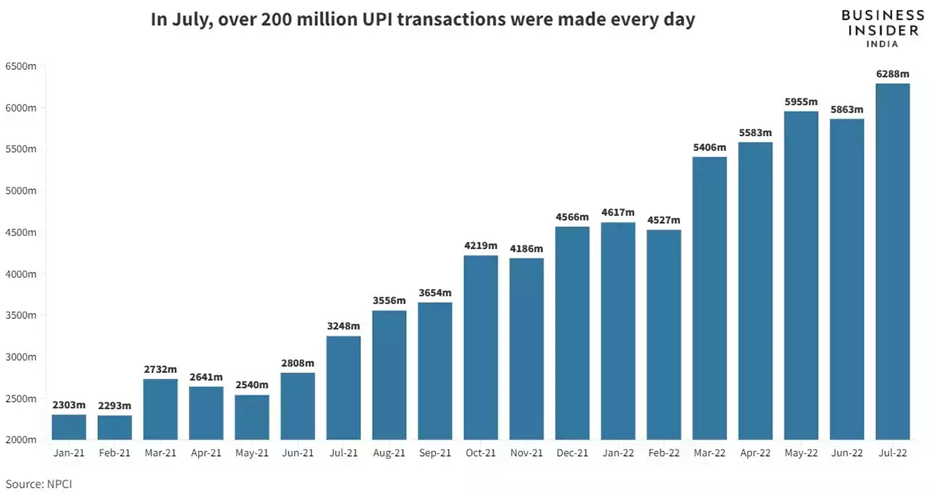
In July 2022, over 200 million UPI transactions were made every day

HBM Layout (Source: NPCI)

In the current digital age, where ease and speed are critical, UPI has come to represent financial emancipation. Because of its real-time settlement, bank-to-bank interoperability, and ongoing innovation from different service providers, UPI is now considered a pillar of India’s digital financial infrastructure. It is clear as we dig deeper into the details of UPI—from its benefits and drawbacks to the inner workings of the market and backend—that it is more than just a payment interface. Rather, it is a driving force behind a significant change in the way financial transactions are carried out, ushering in a new era in India’s digital economy.

How UPI Works

NPCI’s Role: The National Payments Corporation of India (NPCI) plays a pivotal role in the backend operations of UPI. It operates the central switch that facilitates the routing of transactions between different banks. Acting as an umbrella organization for retail payments, NPCI ensures interoperability among various banks and service providers.

UPI Servers and Infrastructure: The backbone of UPI is a robust server infrastructure that manages the vast volume of transactions in real-time. UPI servers act as the intermediaries that process and route transaction requests between the sender’s and recipient’s banks.

Bank Servers and Integration: Each participating bank in the UPI ecosystem maintains its servers that are integrated with the UPI platform. These servers are responsible for handling transaction requests from their respective customers. The integration ensures that the UPI system can communicate seamlessly with the individual banking systems.

Unique IDs and Virtual Payment Addresses (VPAs): At the heart of UPI transactions are the unique identifiers known as Virtual Payment Addresses (VPAs). These VPAs, in the form of “yourname@bank,” serve as the user’s identity and eliminate the need for sharing sensitive information like account numbers and IFSC codes during transactions.

APIs and Protocols: Application Programming Interfaces (APIs) are the bridges that enable communication between different entities in the UPI ecosystem. UPI relies on standardized protocols and APIs to ensure that transactions are executed smoothly across various banks and UPI-enabled apps.

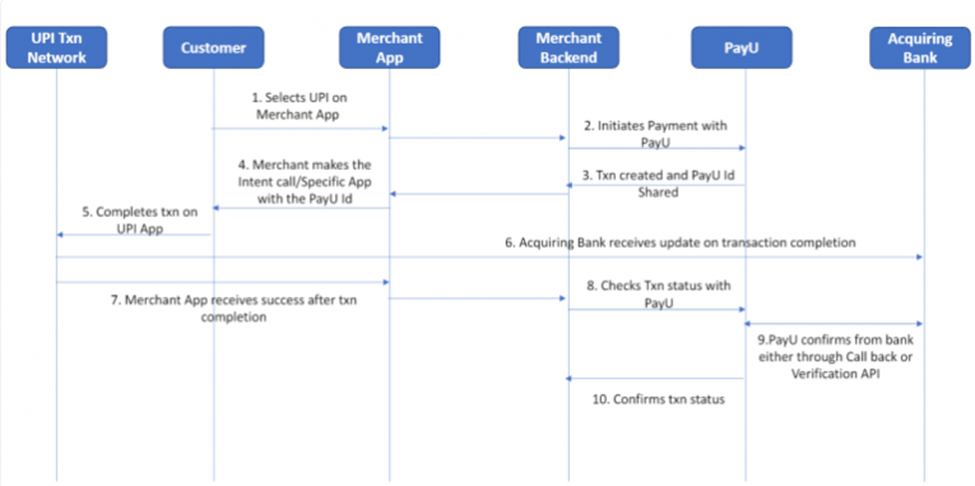
Transaction Request Flow: When a user initiates a UPI transaction, the request flows through a predefined sequence of steps. The sender’s UPI app sends a request to the UPI server, specifying the recipient’s VPA and the transaction amount. The UPI server then communicates with the sender and recipient banks to verify and authorize the transaction.

Authentication Mechanism: Security is a top priority in UPI transactions. The backend employs strong authentication mechanisms, typically involving a secure Personal Identification Number (PIN). This PIN ensures that only the authorized user can initiate and approve transactions.

Real-Time Settlement: UPI is known for its real-time settlement feature. Once the transaction is authenticated, the backend systems ensure an immediate transfer of funds from the sender’s bank to the recipient’s bank. This quick settlement is a key factor in the widespread adoption and popularity of UPI.

Transaction Status and Confirmation: Throughout the process, the backend systems keep track of the transaction status. Both the sender and the recipient receive immediate notifications and confirmations, providing transparency and assurance about the success of the transaction.

Continuous Monitoring and Security Measures: The backend operations of UPI involve continuous monitoring for any suspicious activities or potential security threats. Robust security measures, including encryption and multi-factor authentication, are in place to safeguard user data and financial transactions.

UPI Transactions Backend

UPI working (Source: Payu)

Advantages of UPI

Seamless Transactions: UPI facilitates seamless transactions by eliminating the need for traditional banking processes. Users can send and receive money with just a few taps on their smartphones, making it incredibly user-friendly.

24/7 Accessibility: Unlike traditional banking hours, UPI transactions can be conducted 24/7, providing users with unparalleled accessibility and flexibility. This round-the-clock availability has significantly enhanced the efficiency of financial transactions.

Interoperability: UPI is designed to be interoperable across various banks, allowing users to link multiple bank accounts to a single UPI ID. This interoperability promotes financial inclusivity and ensures that users are not restricted to a particular banking network.

Instant Fund Transfer: One of the key advantages of UPI is its real-time fund transfer capability. Money is transferred instantly between accounts, reducing the waiting time associated with traditional banking methods like NEFT or RTGS.

QR Code Integration: UPI payments are further simplified through the integration of QR codes. Users can scan QR codes to initiate transactions, making it a convenient option for both merchants and consumers.

Disadvantages of UPI

Cybersecurity Concerns: With the surge in digital transactions, UPIs have become a target for cybercriminals. Issues such as phishing attacks and fraudulent transactions pose significant challenges, emphasizing the need for robust cybersecurity measures.

Dependency on Technology: UPI transactions heavily depend on technology and internet connectivity. This dependency may pose challenges for users in remote areas with limited access to a stable internet connection.

Transaction Limits: While UPI supports quick transactions, there are often limits imposed on the amount that can be transferred in a single transaction. This limitation can be inconvenient for users looking to make large transactions.

Lack of Awareness: Despite its widespread adoption, there is still a segment of the population unfamiliar with UPI. The lack of awareness and understanding of digital payment systems may hinder its full-scale adoption across all demographics.

Market Players and Competition

PhonePe: PhonePe, a popular UPI-based payment app, has gained significant traction with its user-friendly interface and seamless integration with various services. Acquired by Flipkart, PhonePe has become a major player in the digital payment space.

Google Pay: Google Pay, powered by UPI, has emerged as a strong contender in the market. Its integration with the Android ecosystem and intuitive features has attracted a large user base, making it a dominant force in the UPI landscape.

Paytm: Paytm, initially known for its mobile wallet, has seamlessly integrated UPI into its platform. With a diverse range of services, including bill payments and online shopping, Paytm remains a prominent player in the UPI market.

BHIM (Bharat Interface for Money): Developed by NPCI, BHIM is a UPI-based app that aims to simplify digital transactions for users across different banks. Its focus on promoting financial inclusion and interoperability makes it a notable player in the UPI space.