
Intellect-Partners

Categories
Computer Science

Zero Trust Security: Why Traditional Firewalls Aren’t Enough

Introduction

With the quickly changing digital age, cybersecurity is now a top priority for organizations, governments, and individuals. Old security architectures that focus on perimeter defenses like firewalls are being left behind by the sophistication and magnitude of contemporary cyber threats. As organizations adopt cloud computing, remote work, and deploy Internet of Things (IoT) devices, the perimeter of a secure network is increasingly fuzzy. This new paradigm has spawned a new model of cybersecurity.

Zero Trust Security

The Legacy of Classic Firewalls

Fundamentally, a firewall is a software barrier that screens traffic through pre-programmed rules, separating what’s considered secure from what isn’t. Classically, firewalls have worked on the axiom that anything within a network can be trusted, and anything outside of it is potentially dangerous. This model was the foundation of enterprise security for many years.

The perimeter-based security architecture, though, was intended for a world in which everything users, applications, and data all sat behind an internal network. Employees typed away from office desktops, and sensitive data sat on on-premise servers. With these conditions, controlling access at the perimeter made sense. But the digital landscape has changed, rendering this model outdated and vulnerable.

The Limitations of Traditional Firewalls

The biggest failing of old firewalls is that it has in fact, eaten away at the network perimeter. The world has become cloud friendly, and is more inclined towards remote working with frequent access to the corporate resources from outside the office on personal devices or unsecured networks. Firewalls have minimal visibility or control over this activity. Therefore, attackers no longer must pierce strong network perimeters they just log in.

In addition, conventional firewalls are based on a model of implicit trust. Once a user or device gains once it enters the network, it is generally given wide access to internal systems and data. This creates an environment in which a single compromised endpoint can result in a catastrophic breach. Cyber attackers use this to their advantage by hijacking stolen credentials or malware to move laterally throughout the network, accessing sensitive information without popping up immediate red flags.

Another key problem is that firewalls are not cloud-native. Contemporary organizations tend to employ a hybrid of public cloud services, private data centers, and SaaS platforms. Firewalls, which were made for static environments, cannot enforce security policies uniformly in such dynamic infrastructures. Their rules and configurations are manually managed and hence are hard to scale and adapt in real-time.

What Is Zero Trust Security?

Zero Trust is an information technology framework based on the ideology of “never trust, always verify.” Unlike legacy models that trust that internal networks are secure, Zero Trust views every access request, whether it comes from within or without the organization, as suspicious. Access is
only permitted after rigorous identity authentication, device confirmation, and contextual risk evaluation.

In a Zero Trust architecture, least privilege access is a fundamental tenet. Users and devices are granted only the privileges they require to execute a particular set of tasks, nothing additional. This severely minimizes the attack surface and culls the potential impact if a credential is breached.

Micro-segmentation is another main characteristic of Zero Trust. Rather than depending on a solitary, integrated network, organizations segment their infrastructure into silos. Even should an attacker manage to get access into one segment of the system, they cannot easily move over to others. This resource compartmentalization achieves an additional layer of defence and constrains lateral movement.

Core Pillars of Zero Trust

A Zero Trust build consists of a number of inter-dependent elements:

  • Identity and Access Management (IAM): Verifies that only authenticated and approved users to access systems, usually with Multi-Factor Authentication (MFA) and Single Sign-On (SSO) for enhanced security.
  • Continuous Monitoring and Analytics: Zero Trust is not about static trust. The system continuously monitors user behaviour, location, device posture, and network activity to identify anomalies.
  • Device Trust: Not only is access granted based on user identity but also on the trustiness of the device. Is it patched? Is it in compliance with corporate policies?
  • Application and Data Security: Policies enforce secure access at the application layer, ensuring that users only interact with what’s required. Sensitive data is safeguarded through encryption, logging, and monitoring.
  • Zero Trust Network Access (ZTNA): ZTNA supplants traditional VPN solutions by linking users directly to particular applications instead of entire networks, thus reducing exposure.
Why Zero Trust Beats Firewalls

The contrast between Zero Trust and conventional firewalls isn’t philosophical it’s pragmatic.

Zero Trust presumes breach. It works with the expectation that attackers might already be within the network and constructs defences based on this expectation. Conventional firewalls are, on the other hand, reactive and concentrate on keeping threats external, too frequently neglecting what occurs once the perimeter is compromised.

Take the case of an attacker using a phishing attack to obtain valid user credentials. In the typical firewall-based setup, such an attacker would be able to penetrate the network and start exfiltrating information with minimal resistance. The firewall would not notice this internal traffic as malicious. But in a Zero Trust setup, the login attempt would initiate further verification processes. If the access is from an unexpected place or device, it might be blocked entirely. Even if the attacker successfully logs in, they would only have access to a thin slice of resources, and anomalous behaviour would most likely be picked up by analytics tools for rapid action.

Zero Trust in a Cloud-First World

The move towards cloud-native technologies and hybrid workspaces has made Zero Trust not only pertinent but necessary. Companies today are running on numerous cloud environments, SaaS offerings, and distributed teams geographically. Within these setups, the classical concept of “inside the network” is no longer applicable.

Zero Trust naturally belongs to this paradigm by taking security past the perimeter. It gives identity-based access control for all applications, services, and infrastructure irrespective of location. Whether a user is accessing from a corporate laptop in the office or a smartphone at home, their identity and behavior need to be authenticated prior to access.

Challenges of Implementing Zero Trust

Although it has its benefits, putting into practice Zero Trust is no cakewalk. For most organizations, it is a painstaking and resource-hungry process to move away from legacy systems. Identifying all applications, devices, users, and data flow across an organization is a serious task and is essential to effective Zero Trust adoption.

There is also a cultural side. Moving to Zero Trust can bring more restrictive access controls and increased authentication, which will likely meet opposition from users who are used to imperceptible access. With the right communications, training, and user experience design, though, these obstacles can be overcome.

In addition, vendors all don’t define Zero Trust similarly. Companies have diverse options for tools and platforms and need to exercise care in choosing them to verify they are aligned with real Zero Trust practices instead of marketing hype.

Conclusion:

Adopting the Cybersecurity Future
Historical firewalls were the initial defense line in a time when information was centralized, users were static, and threats were comparatively unsophisticated. But in today’s hyper-connected, decentralized digital space, these defenses are insufficient. The trust-based perimeter security model is inherently defective in a world where attacks can come from anywhere externally or internally.

Zero Trust Security provides a revolutionary strategy for this new world. By constantly verifying identity, implementing least privilege, and inspecting all attempts at access, organizations can construct strong, adaptive, and proactive security designs. Zero Trust is not a fad it’s a strategic imperative for any organization hoping to survive in the midst of today’s cyberattacks.

As cyberattacks increase in sophistication and the attack surface keeps growing, only those who trust no one and validate everything will stay safe.
Categories
Computer Science Electronics

Unlocking the 6G Future: Harnessing the Potential of Reconfigurable Intelligent Surfaces (RIS)

INTRODUCTION

With each successive generation of communication technology, telecommunication’s primary focus undergoes a transformation. The 2G and 3G epochs were primarily centered on human-to-human communication through voice and text. The advent of 4G marked a pivotal shift toward the extensive consumption of data, while the 5G era prioritized connecting the Internet of Things (IoT) and industrial automation systems.

In the forthcoming 6G era, intelligent computation will drive efficiency and improved human experience. While there is still ongoing innovation in 5G, with the introduction of 5G-Advanced standards, companies have already embarked on research for 6G, with plans to make it commercially available by 2030.

CHARACTERISTICS FOR 6G TECHNOLOGY

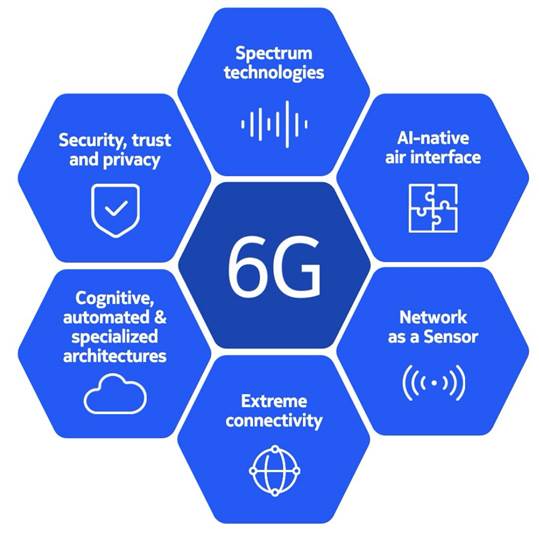
According to Nokia Bell Labs, six technology areas are expected to characterize 6G networks. These areas move the industry from faster connectivity alone toward intelligent, secure, sensor-rich and highly automated communication systems.

Figure 1: Six key technology areas expected to characterize 6G networks.

Artificial intelligence and machine learning – AI/ML techniques, especially deep learning, have rapidly advanced over the last decade and have already been deployed across domains involving image classification and computer vision, ranging from social networks to security. 5G will unleash the true potential of these technologies; with 5G-Advanced, AI/ML will be introduced into many parts of the network, across multiple layers and functions. From beam-forming optimization in the radio layer to scheduling at the cell site with self-optimizing networks, AI/ML can help achieve better performance at lower complexity.

Spectrum bands – Spectrum is a crucial element in providing radio connectivity. Every new mobile generation requires new pioneer spectrum to fully exploit the benefits of a new technology. Refarming existing mobile communication spectrum from legacy technology to the new generation will also become essential. New pioneer spectrum blocks for 6G are expected to include mid-bands of 7-20 GHz for urban outdoor cells enabling higher capacity through extreme MIMO, low bands of 460-694 MHz for extreme coverage, and sub-THz bands for peak data rates exceeding 100 Gbps.

A network that can sense – One of the most notable aspects of 6G would be its ability to sense the environment, people and objects. The network becomes a source of situational information, gathering signals that bounce off objects and determining type, shape, relative location, velocity and perhaps even material properties. This sensing mode can help create a mirror or digital twin of the physical world in combination with other sensing modalities, extending our senses to every point the network touches. Combining this information with AI/ML will provide new insights from the physical world and make the network more cognitive.

Extreme connectivity – The Ultra-Reliable Low-Latency Communication (URLLC) service that began with 5G will be refined and improved in 6G to address extreme connectivity requirements, including sub-millisecond latency. Network reliability could be amplified through simultaneous transmission, multiple wireless hops, device-to-device connections and AI/ML. Enhanced mobility combined with lower latency and improved reliability will support real-time video communications, holographic experiences and digital twin models updated in real time through the deployment of video sensors.

New network architectures – 5G is the first system designed to operate in enterprise and industrial environments, replacing wired connectivity. As demand and strain on the network increase, industries will require more advanced architectures that support greater flexibility and specialization. 5G is introducing service-based architecture in the core and cloud-native deployments that will be extended to parts of the RAN, with networks deployed in heterogeneous cloud environments involving private, public and hybrid clouds. As the core becomes more distributed and higher layers of the RAN become more centralized, there will be opportunities to reduce cost by converging functions. New network and service orchestration solutions exploiting AI/ML advances will result in an unprecedented level of network automation and lower operating costs.

Security and trust – Networks of all types are increasingly becoming targets of cyber-attacks. The dynamic nature of these threats makes sturdy security mechanisms imperative. 6G networks will be designed to protect against threats such as jamming. Privacy issues will also need to be considered when new mixed-reality worlds combine digital representations of real and virtual objects.

RECONFIGURABLE INTELLIGENT SURFACES (RIS)

A Reconfigurable Intelligent Surface (RIS) is a flat panel with small passive elements, approximately in the range of 1 cm2, each capable of independently adjusting the phase and potentially the amplitude of incident electromagnetic waves. Through precise control of these elements, reradiated waves can be directed toward specific directions with the help of an RIS controller. This enables alternative links within a cell and facilitates communication in non-line-of-sight scenarios, supporting extreme connectivity, AI/ML-based signal augmentation, innovative network architecture and optimized bandwidth utilization.

RIS can be fashioned as self-configuring elements within wireless network infrastructure, fine-tuning electromagnetic attributes in response to shifting traffic demands and propagation characteristics. RIS is conceptually appealing and offers practical implementation advantages because it does not require energy-hungry radio-frequency (RF) chains. The absence of RF chains makes RIS an energy-efficient and cost-effective solution compared with massive MIMO technology, which requires an RF chain for each antenna element and therefore increases hardware cost, complexity and power consumption.

Because RIS is highly passive and requires minimal power for operation, it can be an eco-friendly and cost-effective solution deployable on surfaces such as walls, ceilings, billboards and other infrastructure. However, RIS design still requires careful consideration of coverage range, surface size and the number of elements needed.

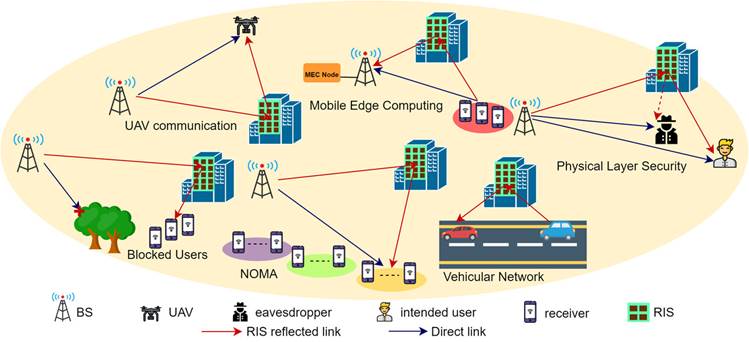
Figure 2: Representative RIS-assisted network scenarios, including blocked users, UAV communication, mobile edge computing, vehicular networks, NOMA and physical-layer security.

Source: IET Communications RIS article, as shown in the source image.

PATENT ACTIVITY AND COMPETITIVE LANDSCAPE

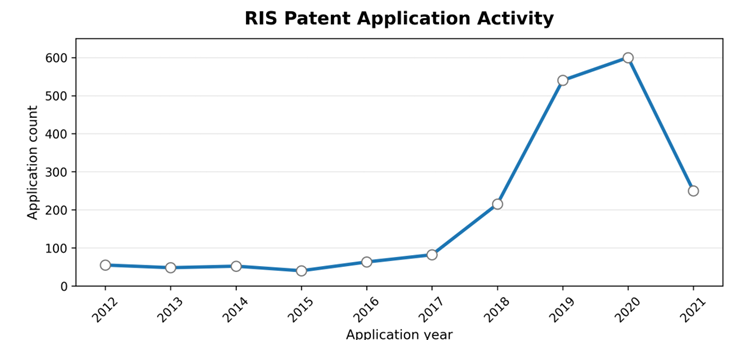
RIS technology is gaining traction among researchers in 5G-Advanced and 6G. After the standardization of 5G in 2019, patenting activity in RIS technology accelerated because RIS promises gains in spectral and energy efficiency without the expense of massive cell densification, while also unlocking numerous future telecommunication use cases.

Figure 3: RIS patent application activity by application year.

Source note: Patent analysis using Orbit Intelligence; values reconstructed from the provided screenshot.

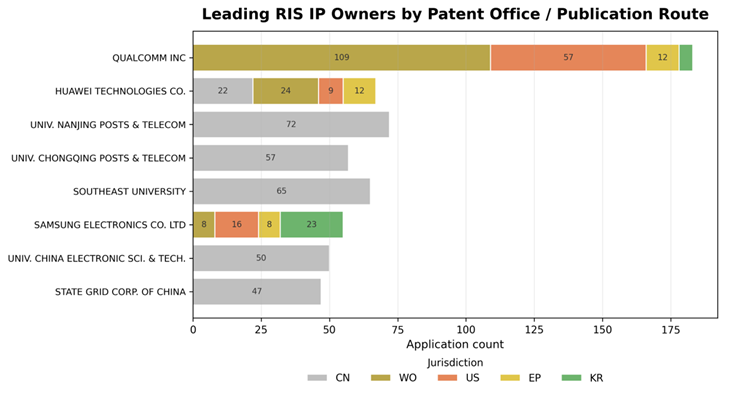
The patent landscape view indicates that the top owners of IP related to RIS technology include Qualcomm, Huawei and Samsung. Several Chinese universities are also actively researching in this area, and China constitutes a substantial share of the global RIS patent landscape.

Figure 4: Leading RIS IP owners visible in the source landscape view by patent office or publication route.

Source note: Patent analysis using Orbit Intelligence; data reconstructed from the provided screenshot.

CONCLUSION

6G is expected to extend mobile networks beyond connectivity by embedding intelligence, sensing, automation, security and extreme performance into the network fabric. RIS is highly aligned with this direction: by shaping the wireless propagation environment itself, RIS can create alternative links, improve non-line-of-sight coverage, reduce energy consumption and support new architectures for dense, intelligent and adaptive wireless systems.

As patenting activity and research investment increase, RIS is likely to remain a key enabling technology in the transition from 5G-Advanced toward commercial 6G systems.

REFERENCES

Categories
Others

Intellect Partners – Our Security, Customer Focus, and Unique Approach

Download Intellect Partners’ new Whitepaper for a nitty-gritty point of view of our continuous commitment to security, privacy, and consistency.

In this undeniably advanced connected world, all organizations, regardless of their area of operations, need to guarantee that they have the fitting degree of digital trust. As such, the proportion of confidence partners will have in an organization’s capacity to safeguard their private data and secure their information.

Our new Whitepaper explains our far-reaching responsibility for security, privacy, and consistency. Created in view of our clients, we offer deep insights and answers into how we can oblige most prerequisites with regards to the confidentiality and security of information.

You can download the full Whitepaper from here:

* Do you trust your IP partners with your information?

* Do they have advanced security measures to prevent a data breach?

* Does your IP partner prioritize Data Privacy?

If you are blank reading all these questions, Maybe it is time to switch to Intellect Partners.