Intellect-Partners

Categories
Others

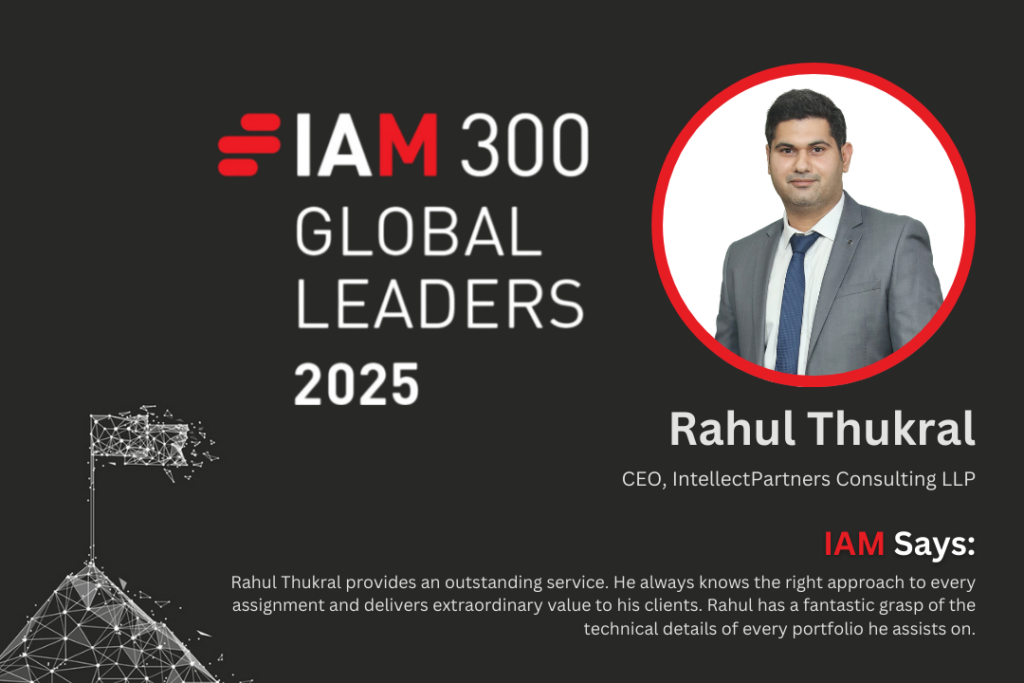
Intellect Partners Consulting LLP Leadership Honored in IAM Strategy 300 Global Leaders 2025

Intellect Partners Consulting LLP proudly announces that our CEO, Rahul Thukral, has been named among the distinguished IAM Strategy 300 Global Leaders 2025. This prestigious accolade acknowledges his extraordinary contributions to intellectual property (IP) strategy and innovation consulting, highlighting his expertise and influence within the global IP community.


Rahul Thukral: Transforming IP Consulting with Vision and Leadership

Rahul Thukral, CEO of Intellect Partners Consulting LLP, has consistently exemplified leadership, innovation, and excellence in intellectual property consulting. Through his visionary approach, he has redefined how businesses develop, manage, and monetize their IP assets. His strategic insights have enabled organizations across various industries to unlock significant value from their intellectual property, driving growth and creating sustainable competitive advantages.

Under Rahul’s leadership, Intellect Partners has become a trusted advisor to enterprises worldwide. The firm specializes in delivering expert solutions across IP strategy, litigation support, portfolio management, and monetization. Rahul’s ability to address complex IP challenges with tailored, forward-thinking strategies has not only fueled the company’s growth but also positioned it as an industry leader. His client-centric approach and dedication to driving impactful results continue to shape the firm’s reputation as a preferred partner for businesses navigating the intricate IP landscape.


Celebrating Excellence in Global IP Leadership

Rahul Thukral’s inclusion in the IAM Strategy 300 Global Leaders 2025 represents a significant milestone, underscoring his profound impact on the global IP ecosystem. This recognition reflects his steadfast commitment to empowering businesses with innovative IP strategies, fostering value creation, and supporting long-term success through thoughtful and strategic decision-making.

At Intellect Partners Consulting LLP, we take immense pride in this achievement. Rahul’s recognition inspires us to continue delivering cutting-edge IP solutions that empower our clients to thrive in an increasingly competitive and innovation-driven world. We remain dedicated to helping organizations maximize the potential of their intellectual property, ensuring they achieve meaningful and lasting business outcomes.

Categories
Others

Intellect Partners Shines in IAM Patent 1000 Debut: Elevating Patent Solutions to New Heights

Intellect Partners Consulting, a leading provider of comprehensive patent solutions, is proud to announce its recent recognition in the esteemed IAM Patent 1000 as a “Highly-recommended Firm” in transactions. This achievement underscores our unwavering commitment to excellence and innovation in the realm of intellectual property.

The inclusion in IAM Patent 1000, renowned for its rigorous evaluation process, reflects our dedication to delivering top-tier services in licensing, monetization, and contentious patent matters. Abhay Dangayach, Associate Director- IP R&D Solutions at Intellect Partners, expressed his excitement, stating, “We are thrilled to be recognized by IAM. This acknowledgment is a testament to the dedication and expertise of our entire team, validating our commitment to providing innovative and effective solutions.”

Client Testimonials Highlight Intellect Partners’ Strengths

IAM Patent 1000 also spotlights the positive experiences of our clients:

  • “Rahul Thukral offers a compelling blend of strong business sense and technical proficiency.”
  • “Intellect Partners consistently delivers quality work, hits deadlines, and communicates effectively.”
  • “The team provides comprehensive services across various technologies, including company/product research and patent portfolio analysis.”
A Technologically Savvy Team Delivering Exceptional Service

With a team of 40+ experienced patent experts and state-of-the-art laboratories, Intellect Partners offers a wide range of services, from reverse engineering and in-house testing to patent analysis and claim chart development. Our multidimensional approach ensures that clients receive tailored solutions to meet their patent objectives efficiently and effectively.

Experience the Advantage with Intellect Partners

At Intellect Partners, we distinguish ourselves through our comprehensive approach to patent services. With a collaborative team of 40+ patent agents & engineers, supported by cutting-edge laboratories, we offer unparalleled expertise to our clients. Our professionals not only possess legal acumen but also boast extensive technical backgrounds, enabling us to address the multifaceted challenges of the modern patent landscape effectively.

Our unique blend of expertise empowers us to:

  • Execute high-quality reverse engineering and internal testing of original products.
  • Conduct thorough research on each patent and its application, drawing insightful comparisons with similar samples.
  • Develop clear and logical claim charts.
  • Craft professional plans tailored to your organization’s unique needs, bringing exceptional ideas to fruition.

With Intellect Partners, you can trust in our commitment to delivering comprehensive patent solutions that drive your success.

Intellect Partners is at the forefront of innovation in patenting, offering unparalleled expertise in licensing, monetization, litigation, and patent portfolio management. Rooted in contemporary values and driven by a passion for excellence, we are dedicated to empowering our clients to achieve their patent objectives effectively.

IAM Patent 1000: Recognized Team Members

We are delighted to share the news that two of our esteemed colleagues, Rahul Thukral and Tanya Chauhan, have been honored as recommended individuals in the esteemed IAM 1000 2024 listing! This recognition is a testament to the collaborative efforts of our entire team in advancing success through strategic IP initiatives. Discover what IAM has to say about us by visiting: https://www.iam-media.com/rankings/patent-1000/profile/firm/intellect-partners

IAM Patent 1000: A Global Recognition of Excellence

As a participant in IAM Patent 1000, Intellect Partners joins the ranks of the world’s top patent professionals and agencies. This prestigious directory provides invaluable insights into the global patent market, helping businesses identify the best partners for prosecution, litigation, and licensing, and all patent matters.

Contact Intellect Partners today to experience the advantage first-hand and learn how our team can help you achieve your patent objectives. Visit our website at www.intellect-partners.com  or email us at info@intellect-partners.com in case of any queries.

Categories
Electronics Others

Migration from Hybrid Memory Cube (HMC) to High-Bandwidth Memory (HBM)

Introduction:

Memory technology plays a vital role in providing effective data processing as the demand for high-performance computing keeps rising. The industry has recently seen a considerable migration from Hybrid Memory Cube (HMC) to High-Bandwidth Memory (HBM) because of HMB’s higher performance, durability, and scalability. This technical note talks about the causes behind the widespread adoption of HBM as well as the benefits it has over HMC.

HBM Overview:

HBM is a revolutionary memory technology that outperforms conventional memory technologies. HBM is a vertically stacked DRAM memory device interconnected to each other using through-silicon vias (TSVs). HBM DRAM die is further tightly connected to the host device using its distribution channels which are completely independent of one another. This architecture is used to achieve high-speed, low-power operation. HBM has a reduced form factor because it combines DRAM dies and logic dies in a single package, making it ideal for space-constrained applications. An interposer that is interconnected to the memory stacks, enables high-speed data transmission between memory and processor units. 

HMC Brief:

The Hybrid Memory Cube (HMC) comprises multiple stacked DRAM dies and a logic die, stacked together using through-silicon via (TSV) technology in a single-package 3D-stacked memory device. The HMC stack’s memory dies each include their memory banks as well as a logic die for memory access control. It was developed by Micron Technology and Samsung Electronics Co. Ltd. in 2011, and announced by Micron in September 2011.

When compared to traditional memory architectures such as DDR3, it enables faster data access and lower power consumption. Each memory in HMC is organized into a vault. Each vault in the logic die has a memory controller which manages memory operations. HMC is used in applications where speed, bandwidth, and sizes are more required. Micron discontinued the use of HMC in 2018 when it failed to become successful in the semiconductor industry.

Hybrid Memory Cube (HMC) and High-Bandwidth Memory (HBM) are two distinct memory technologies that have made significant contributions to high-performance computing. While both of these technologies aim to enhance memory bandwidth operation, there are many fundamental distinctions between HMC and HBM.

Power Consumption: HBM significantly has lower power consumption compared to HMC. HBM’s vertical stacking approach eliminates high-power consumption bus interfaces and reduces the distance for data transfer between DRAM dies, resulting in improved energy efficiency. This decreased power usage is especially beneficial in power-constrained environments like mobile devices or energy-efficient servers.

Memory Architecture: HMC uses a 3D-stacked memory device comprised of several DRAM dies and a logic die stacked together via through-silicon (TSV) technology. In addition to its memory banks, each memory die in the HMC stack contains a logic die for a memory access operation. HBM, on the other hand, is a 3D-stacked architecture that integrates base (logic) die and memory dies as well as a processor (GPU) on a single package that is coupled by TSVs to provide a tightly coupled high-speed processing unit. The memory management process is made easier by the shared memory space shared by the memory dies in an HBM stack.

Industry Adoption: When compared to HMC, HBM offers more memory density in a smaller physical footprint. HBM does this by vertically stacking memory dies on a single chip, resulting in increased memory capacity in a smaller form factor. HBM is well-suited for space-constrained applications such as graphics cards and mobile devices because of its density.

Memory Density: In comparison to HMC, HBM frequently utilizes less energy and power. The vertical stacking strategy used by HBM shortens the transfer of data distance and removes power-hungry bus connections, resulting in increased energy efficiency. This decreased power usage is especially beneficial in power-constrained contexts like mobile devices or energy-efficient servers.

Memory Bandwidth: Comparing HMC and HBM to conventional memory technologies, they both offer much better memory bandwidth. On the other hand, HBM often delivers higher bandwidth compared to HMC. By using a wider data channel and higher signaling rates, HBM accomplishes this, enabling faster data flow between the processor and the memory units.

In conclusion, HMC and HBM differ in terms of memory bandwidth, architecture, power consumption, density, and industry recognition. While HMC offers significantly better performance over conventional memory technologies, HBM has become the market leader due to its reduced form factor, higher performance, and efficiency, which has expedited the transition from HMC to HBM.

Advantages of HBM:

Power Consumption: HBM uses less energy and power for data transfer on the I/O interface than HMC, hence lowering energy efficiency. HBM improves energy efficiency by using vertical stacking technology to reduce data transfer distance and power-intensive bus interfaces.

Bandwidth: HBM provides excellent memory bandwidth, allowing the processor/controller to quickly access data to obtain greater speed. HBM has more memory channels and along with high-speed signaling than HMC, which allows for more bandwidth. This high bandwidth is critical for data-intensive applications such as AI, machine learning, and graphics.

Scalability: By enabling the connection of different memory stacks, HBM offers scalable memory configurations. Because of this flexibility, numerous memory and bandwidth options are available to meet the unique needs of various applications.

Density: With a reduced size, HBM’s vertical stacking technique makes greater memory densities possible. HBM memory is ideal for smaller devices such as mobile phones and graphics cards etc. Enhanced system performance is also made possible by higher memory density by lowering data access latency.

Signal Integrity: TSV-based interconnects in HBM provide superior signal integrity than wire-bonded techniques. The reduced data transmission failures and increased system dependability are both benefits of improved signal integrity.

Conclusion:

A significant development in memory technology is the change from HMC to HBM. The requirement for faster and more effective memory solutions has been spurred by the demand for high-performance computing, particularly in fields like AI, machine learning, and graphics. With its different benefits, HBM is broadly utilized in various ventures because of its high bandwidth, low power consumption, increased density, versatility, and improved signal integrity. HBM has become the standard option for high-performance memory needs, and its continuous development is expected to influence the direction of memory technologies in the market.