

When assessing a patent for its Standard Essential Patent (SEP) potential, the real challenge often lies not in whether the technology is relevant but in proving it, rigorously and clause by clause, against a living standard document. Most patents appear to map cleanly at first glance. The difficulty emerges when claim language carries abstract mathematical constructs, frequency-domain descriptions, and signal-processing logic that must be traced to specific normative text in the standard.
A recent Wi-Fi SEP evaluation project focused on US 12XXXX75, a patent covering a method for a wake-up receiver (WUR). It began with a deceptively simple question from the client:
“Does this patent read on the IEEE 802.11-2024 standard and can it be monetized?”
On the surface, the patent’s claims described a method for receiving a wake-up signal (WUS) over a frequency range, filtering it through a channel-selective filter, and modulating the signal on two or more equidistantly spaced carrier frequencies. These are real and specific engineering choices. But the challenge was proving, mathematically and normatively, that every element of the independent claim found its exact counterpart in the IEEE 802.11-2024 standard including one particularly intricate geometric relationship buried in the final claim limitation.
The preliminary read of the patent was encouraging. The independent claim describes a method for a WUR that:
- Receives a wake-up signal (WUS) over a frequency range with a signal bandwidth
- Filters the received WUS through a filter with a defined filter bandwidth
- Modulates the digital WUS sequence on two or more equidistantly spaced carrier frequencies
- Requires that the lowest and highest carrier frequencies are each separated from the respective edge of the frequency range by half the carrier frequency interval
The IEEE 802.11-2024 standard’s Section 30 Wake-Up Radio (WUR) PHY specification defines precisely this type of receiver-side operation. The WUR PHY uses multicarrier on-off keying (MC-OOK) to transmit and receive WUR signals within a 20 MHz operating channel, using a specific set of equidistant subcarriers. The alignment was strong but incomplete without resolving the final limitation.
The limitation is where the mapping became technically demanding. The claim requires that:
“…a lowest one of the carrier frequencies and a highest one of the carrier frequencies of the … from a respective edge of the frequency range.”
This is not a qualitative description. It is a quantitative geometric claim about the placement of the outermost active subcarriers relative to the edges of the transmission channel. Proving it required going beyond the normative text and solving the underlying signal-processing mathematics directly from the standard’s parameters.
Working Through the Mathematics
The IEEE 802.11-2024 standard defines the following parameters for MC-OOK transmission:
- Active subcarrier indices: k = (−6, −4, −2, 2, 4, 6)
- Subcarrier spacing: Δf = 312.5 kHz
- IDFT size: 64-point, sampled at 20 MHz
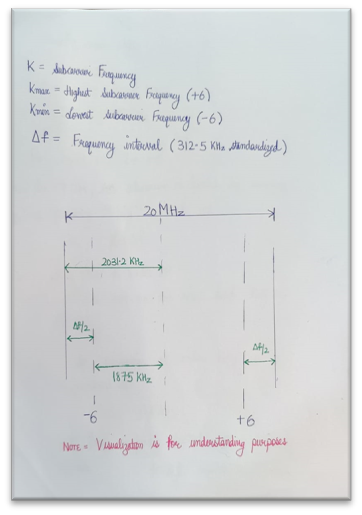
The outermost active subcarriers sit at k = ±6. Their frequency offsets from the channel center are:
f_outer = ±6 × 312.5 kHz = ±1875 kHz
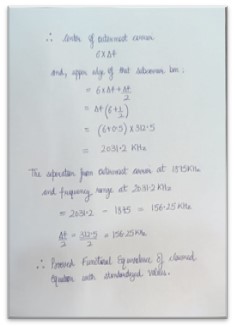
Now, where is the “edge of the frequency range”? In OFDM-based systems, the edge of the frequency range defined by the subcarrier grid is conventionally placed at half a subcarrier spacing beyond the outermost subcarrier that is, at (k_max + 0.5) × Δf:
f_edge = (6 + 0.5) × 312.5 kHz = 6.5 × 312.5 kHz = ±2031.25 kHz
The separation between the outermost active carrier and the edge of the frequency range is therefore:
f_edge − f_outer = 2031.25 kHz − 1875 kHz = 156.25 kHz
And half the carrier frequency interval (Δf/2) is:
312.5 kHz / 2 = 156.25 kHz
The two values are identical. The lowest and highest active carrier frequencies are each separated from the respective edge of the 20 MHz frequency range by exactly half the subcarrier spacing of 312.5 kHz, confirming the claimed relationship.
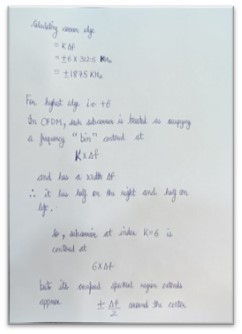
This was the breakthrough. The claim’s final limitation, which appeared abstract, is in fact a direct mathematical consequence of the MC-OOK subcarrier placement defined in IEEE 802.11-2024 Clause 30.
With the SEP status established including the resolution of the challenging final limitation the analysis unlocked several downstream opportunities for the patent owner:
- Licensing leverage. The confirmed mapping to IEEE 802.11-2024 provides a concrete, defensible basis for licensing discussions with device manufacturers implementing Wi-Fi 6/6E WUR functionality. Any chipset or device that supports the WUR PHY as defined in 802.11-2024 Clause 30 is a potential licensing target.
- Portfolio positioning. Wi-Fi 6 and Wi-Fi 6E deployments have accelerated significantly across consumer electronics, IoT devices, enterprise networking, and automotive applications. WUR, specifically, addresses the low-power connectivity use case central to battery-powered IoT. A confirmed SEP in this space carries real commercial weight.
- Prosecution and portfolio strategy. The mathematical derivation work produced during the mapping exercise particularly the subcarrier edge-separation proof can inform continuation filings or claim amendments that more explicitly recite the standard-compliant parameters, potentially strengthening the patent family’s licensing position further.
The Wi-Fi 6 WUR mapping project is a good illustration of what rigorous SEP analysis looks like when the standard doesn’t hand you the answer directly. The technology was clearly aligned. The standard was clearly relevant. But the final link a specific, quantitative geometric relationship between subcarrier placement and channel edges required working through the mathematics of the OFDM subcarrier grid from first principles.
That is the work. And it is the work that determines whether a patent remains a theoretical asset or becomes an actionable one.