


Intellect-Partners

Categories
Others

When the Standard Goes Silent, the Math Must Speak to Prove Essentiality

When assessing a patent for its Standard Essential Patent (SEP) potential, the real challenge often lies not in whether the technology is relevant but in proving it, rigorously and clause by clause, against a living standard document. Most patents appear to map cleanly at first glance. The difficulty emerges when claim language carries abstract mathematical constructs, frequency-domain descriptions, and signal-processing logic that must be traced to specific normative text in the standard.

A recent Wi-Fi SEP evaluation project focused on US 12XXXX75, a patent covering a method for a wake-up receiver (WUR). It began with a deceptively simple question from the client:

“Does this patent read on the IEEE 802.11-2024 standard and can it be monetized?”

On the surface, the patent’s claims described a method for receiving a wake-up signal (WUS) over a frequency range, filtering it through a channel-selective filter, and modulating the signal on two or more equidistantly spaced carrier frequencies. These are real and specific engineering choices. But the challenge was proving, mathematically and normatively, that every element of the independent claim found its exact counterpart in the IEEE 802.11-2024 standard including one particularly intricate geometric relationship buried in the final claim limitation.

The preliminary read of the patent was encouraging. The independent claim describes a method for a WUR that:
  1. Receives a wake-up signal (WUS) over a frequency range with a signal bandwidth
  2. Filters the received WUS through a filter with a defined filter bandwidth
  3. Modulates the digital WUS sequence on two or more equidistantly spaced carrier frequencies
  4. Requires that the lowest and highest carrier frequencies are each separated from the respective edge of the frequency range by half the carrier frequency interval

The IEEE 802.11-2024 standard’s Section 30 Wake-Up Radio (WUR) PHY specification defines precisely this type of receiver-side operation. The WUR PHY uses multicarrier on-off keying (MC-OOK) to transmit and receive WUR signals within a 20 MHz operating channel, using a specific set of equidistant subcarriers. The alignment was strong but incomplete without resolving the final limitation.

The limitation is where the mapping became technically demanding. The claim requires that:

“…a lowest one of the carrier frequencies and a highest one of the carrier frequencies of the … from a respective edge of the frequency range.”

This is not a qualitative description. It is a quantitative geometric claim about the placement of the outermost active subcarriers relative to the edges of the transmission channel. Proving it required going beyond the normative text and solving the underlying signal-processing mathematics directly from the standard’s parameters.

Working Through the Mathematics

The IEEE 802.11-2024 standard defines the following parameters for MC-OOK transmission:

  • Active subcarrier indices: k = (−6, −4, −2, 2, 4, 6)
  • Subcarrier spacing: Δf = 312.5 kHz
  • IDFT size: 64-point, sampled at 20 MHz
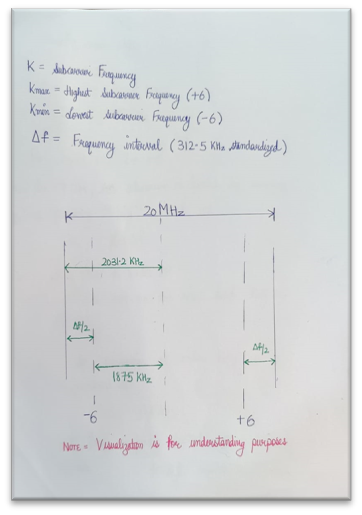
The outermost active subcarriers sit at k = ±6. Their frequency offsets from the channel center are:

f_outer = ±6 × 312.5 kHz = ±1875 kHz

Now, where is the “edge of the frequency range”? In OFDM-based systems, the edge of the frequency range defined by the subcarrier grid is conventionally placed at half a subcarrier spacing beyond the outermost subcarrier that is, at (k_max + 0.5) × Δf:

f_edge = (6 + 0.5) × 312.5 kHz = 6.5 × 312.5 kHz = ±2031.25 kHz

The separation between the outermost active carrier and the edge of the frequency range is therefore:

f_edge − f_outer = 2031.25 kHz − 1875 kHz = 156.25 kHz

And half the carrier frequency interval (Δf/2) is:

312.5 kHz / 2 = 156.25 kHz

The two values are identical. The lowest and highest active carrier frequencies are each separated from the respective edge of the 20 MHz frequency range by exactly half the subcarrier spacing of 312.5 kHz, confirming the claimed relationship.
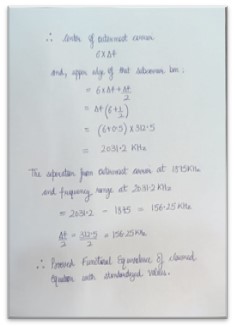
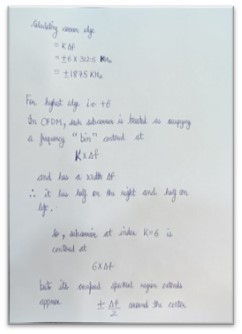
This was the breakthrough. The claim’s final limitation, which appeared abstract, is in fact a direct mathematical consequence of the MC-OOK subcarrier placement defined in IEEE 802.11-2024 Clause 30.

With the SEP status established including the resolution of the challenging final limitation the analysis unlocked several downstream opportunities for the patent owner:

  • Licensing leverage. The confirmed mapping to IEEE 802.11-2024 provides a concrete, defensible basis for licensing discussions with device manufacturers implementing Wi-Fi 6/6E WUR functionality. Any chipset or device that supports the WUR PHY as defined in 802.11-2024 Clause 30 is a potential licensing target.
  • Portfolio positioning. Wi-Fi 6 and Wi-Fi 6E deployments have accelerated significantly across consumer electronics, IoT devices, enterprise networking, and automotive applications. WUR, specifically, addresses the low-power connectivity use case central to battery-powered IoT. A confirmed SEP in this space carries real commercial weight.
  • Prosecution and portfolio strategy. The mathematical derivation work produced during the mapping exercise particularly the subcarrier edge-separation proof can inform continuation filings or claim amendments that more explicitly recite the standard-compliant parameters, potentially strengthening the patent family’s licensing position further.

The Wi-Fi 6 WUR mapping project is a good illustration of what rigorous SEP analysis looks like when the standard doesn’t hand you the answer directly. The technology was clearly aligned. The standard was clearly relevant. But the final link a specific, quantitative geometric relationship between subcarrier placement and channel edges required working through the mathematics of the OFDM subcarrier grid from first principles.

That is the work. And it is the work that determines whether a patent remains a theoretical asset or becomes an actionable one.
Categories
Computer Science Electronics

The evolution of Wi-Fi standards: 802.11a to ax

At
the point when you’re hoping to purchase new wireless networking gear to set up
your home Wi-Fi network, business Wi-Fi organization or to purchase a phone,
you’re confronted with a variety of decisions and abbreviations. The innovation
encompassing Wi-Fi being the biggest offender with regards to abbreviations and
various naming constructions.

Since
Wi-Fi was first released to consumers in 1997, Wi-Fi standards have been advancing
– typically coming about in quicker speeds and further inclusion. With each new
capacity comes a name change to set the guidelines separated. As abilities are
added to the first IEEE 802.11 standard, they become known by their amendment (802.11b,
802.11g, and so forth).

In
2018, the Wi-Fi Alliance took steps to make Wi-Fi standards names more
straightforward to distinguish and comprehend (Wi-Fi 4, Wi-Fi 5, Wi-Fi 6, and
so on)

What might have been known as the “802.11ax standard” is currently more obvious as “Wi-Fi 6.” To follow the new naming construction, the Wi-Fi Alliance re-named the two past standards (802.11n and 802.11ac) to Wi-Fi 4 and 5.The request of all of the Wi-Fi standards from 1999 to introduce are as per the following:

Source: semfionetworks

• 1997 – 802.11b
• 1999 – 802.11b
• 1999 – 802.11a
• 2003 – 802.11g
• 2009 – 802.11n (Wi-Fi 4)
• 2014 – 802.11ac (Wi-Fi 5)
• 2019 – 802.11ax (Wi-Fi 6)
• 2019 – 802.11ax (Wi-Fi 6E)
• Future – 802.11be (Wi-Fi 7)?

802.11b

802.11b utilized a similar 2.4 GHz frequency as the first
802.11 standard. It
upheld a maximum
theoretical rate of 11 Mbps and had a reach up to 150 feet.

02.11b parts were inexpensive, yet the
standard had the slowest maximum
speed of the multitude of 802.11 standards. What’s
more, since 802.11b worked in the 2.4 GHz, home appliances or other 2.4
GHz Wi-Fi networks could
cause obstruction.

Ultimately, 802.11n standard (what might become Wi-Fi 4) went along to replace 802.11a,
802.11b and 802.11g as the new local
network standard (WLAN). (More on Wi-Fi 4 later.)

Today, routers
that only
support 802.11n are not generally made.

802.11a

For what reason did 802.11b before 802.11a?

The ‘a’ amendment
to the standard was delivered simultaneously as 802.11b.
However, it presented a more perplexing method, known as OFDM (Orthogonal Frequency Division Multiplexing) for
creating the wireless
signal.

At the end of the day, 802.11a offered a couple of
benefits over 802.11b:

It worked in the less jam-packed 5 GHz recurrence band,
making it less inclined to interference.

Its transmission capacity was a lot higher than 802.11b,
with a hypothetical max of 54 Mbps.

You likely haven’t experienced numerous 802.11a gadgets
or routers. This is only because 802.11b devices were less expensive and turned
out to be well-known in the consumer market. 802.11a was mainly utilized in
business applications.

802.11g

The 802.11g standard utilized a similar OFDM innovation
presented with 802.11a. Like 802.11a, it upheld a maximum theoretical rate of 54
Mbps. Yet, as 802.11b, it worked in the packed 2.4 GHz recurrence (and
accordingly was subject
to a similar interference
issues as 802.11b).

802.11g was backward compatible with 802.11b devices: a 802.11b
gadget could associate with a 802.11g access point (yet at
802.11b speed rates).

With 802.11g, consumers partook in a critical development in Wi-Fi speeds and range.
Simultaneously, buyer wireless
routers were improving, with higher power and better coverage than earlier generations.

802.11n
(Wi-Fi 4)

With the 802.11n standard, Wi-Fi turned out to be considerably quicker
and more reliable. It
upheld a maximum
theoretical transfer rate of 300 Mbps (and could reach up to 450 Mbps
when utilizing three antennae).

802.11n utilized MIMO (Multiple Input Multiple Output)
where different transmitters/recipients could work simultaneously at one or both ends of the link to a single device.
This gave a huge expansion in data without
requiring a higher data transmission or transmit power.

802.11n worked in both the 2.4 GHz and 5 GHz bands

802.11ac
(Wi-Fi 5)

802.11ac supercharged Wi-Fi, with speeds going from 433 Mbps all the way up to several Gigabits each second. To accomplish this sort of execution, 802.11ac:

• Worked solely in the 5 GHz band
• Supported up to eight spatial streams (contrasted and 802.11n’s four streams)
• Multiplied the channel width up to 80 MHz
• Utilized an technology called beamforming

With beamforming, the antennae essentially transmit the radio signals, so they’re aimed at a particular device.

One more huge advancement with 802.11ac
was multi-client MIMO (MU-MIMO). While MIMO guides various streams to a
solitary client,
MU-MIMO can guide the spatial streams to different devices at the same time.

While MU-MIMO doesn’t add speed to any single client, it
can expand the overall data
throughput of the entire
network.

Wi-Fi 5 was a major advance for Wi-Fi development.
Presently, Wi-Fi is taking one another
big leap from 5 to 6.

Wi-Fi 6
(802.11ax)

The newest
generation Wi-Fi standard is Wi-Fi 6. We were used to Wi-Fi 5 being
supercharged with changes, and presently Wi-Fi 6 offers significantly more.

The greatest things to know about the freshest standard is that Wi-Fi 6:

• Has upgrades similar to 5G.
• Avoids traffic congestion in public spaces.
• Offers higher data rates and capacity, up to 9.6 Gbps.
• Offers better 2.4 GHz and 5 GHz spectrum support.
• Offers expansion in multi-user, multiple input, multiple output (MU-MIMO) from 4 x 4 to 8 x 8.
• Overall, guarantees better and quicker performance.
• Allows you to connect with much more gadgets in your home.

Unlike to
past standards,
Wi-Fi 6 permits one router
to deal with more antennas. Which implies one router can interface
with more gadgets.

Wi-Fi
6 is designed to make wireless internet better in homes and in public.

Wi-Fi 6 is intended to improve remote web in homes and in
broad daylight.

Wi-Fi 6E

You may see Wi-Fi 6E on certain devices. The thing you need to know about Wi-Fi
6E is that it is as old as Wi-Fi
6 aside from one thing: the frequency band that it can extend to. Wi-Fi 6E supports an all-new
6GHz frequency,
which has higher throughputs and lower latency.

Projected
for 2024:

Wi-Fi 7 (802.11be)

In spite of the fact that Wi-Fi 6 just delivered to the
general population, there is now talk about Wi-Fi 7 and what’s to come in the
following in next few
years.

Basically, as history shows, what we can expect is:

• Considerably faster speeds
• Better reach
• Decongested traffic
• Supporting multiple bands at once
• More data squeezed into 4096-QAM (radio signal) to further develop Wi-Fi networks

While Wi-Fi continues to progress, here and there it’s
insufficient on its own.
There are gadgets that can assist with making your home Wi-Fi experience
stunningly better.