The Productivity Ceiling Has Cracked
For the better part of two decades, IP analytics was a game of human endurance. Senior analysts pored over thousands of patents in tightly compressed timelines, making judgment calls on relevance with minimal tooling beyond a keyword search and a spreadsheet. The ceiling was real and it showed up in throughput, margin, and the quality of what ultimately landed on a licensing negotiation table.
At Intellect Partners, we decided to dismantle that ceiling deliberately. Not by replacing our subject-matter experts that would be strategically reckless but by weaponizing AI as a force-multiplier behind every analyst on the team. What follows is not a technology explainer. It is a management account of how a 75-person IP advisory firm restructured its entire research workflow around AI, and what we learned in the process.
Let the Metrics Speak First
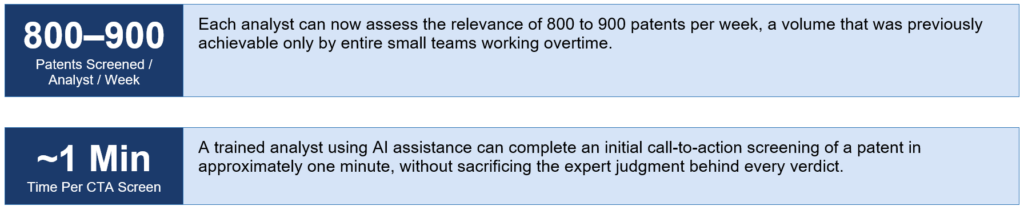
Leaders need outcomes before methodologies. Here is what the AI-augmented workflow delivers for us today:
Where AI Actually Enters the Workflow
The question we hear most from peers and clients is a variation of the same thing: “Where exactly does AI slot in?” The answer is not at the conclusion, it never decides whether a patent infringes. The answer is everywhere that precision matters before a conclusion is reached.
1. Patent Mining: Building the Right Candidate Set
The first failure mode in patent research is a bad keyword strategy. Miss the right Boolean string and you miss the patent. AI has transformed how we approach this:
- For product infringement projects, AI maps every publicly disclosed method and process from a target company, drawing from patents, academic papers, and product documentation to construct exhaustive, target-aware keyword strings.
- For SEP infringement projects, our experts identify common technical processes across 5G NR and Wi-Fi (OFDM, beamforming, channel estimation, HARQ). AI then generates comprehensive Boolean strings that cover every functional interpretation, preventing portfolio gaps before the search even begins.
- Crucially, AI identifies functionally equivalent techniques under Broadest Reasonable Interpretation (BRI) ensuring that inferential mapping is baked into the mining phase, not retrofitted at the claim-charting stage.
The result is a broader, more defensible candidate set and a significantly lower risk of leaving a valuable patent unfound.
2. The 1-Minute CTA Screen : Throughput Without Shortcuts
Screening is where volume pressure used to compromise quality. The traditional model forced analysts to make snap relevance calls on hundreds of patents per day; analyst fatigue was a genuine risk to accuracy.
Our AI-assisted CTA (call-to-action) screening protocol works as a three-step loop: the analyst reads the independent claims and abstract; AI flags the claim elements that map to target product features or relevant standard sections; the analyst then makes the relevance call: Relevant, Maybe, or Not Relevant with AI support, never AI substitution.
The expert retains the final call on every patent, every time. AI amplifies throughput; it does not erode accountability.
3. Deep Searching: Reading Between the Claim Lines
Once a patent clears the initial screen, deep searching begins. This is where AI earns its most significant leverage in technically complex portfolios:
- For product infringement: AI helps analysts move beyond literal claim language, surfacing publicly available information on target implementations that support inferential mapping under BRI.
- For SEP analysis: IEEE and 3GPP standards are dense with mathematical constructs, OFDM subcarrier equations, FFT transforms, signal-processing formulas. AI interprets these equations directly within their standard context, enabling analysts to locate the normative reference that proves or disproves essentiality far faster than manual navigation allows.
4. EoU Mapping: Scaffolding the Claim Chart
Evidence of Use (EoU) mapping is the most labour-intensive deliverable in SEP analysis. AI now scaffolds the first draft:
- It decomposes each independent claim element into discrete functional requirements.
- It cross-references claim language against the relevant standard (IEEE 802.11, 3GPP TS 38.300) to identify candidate normative sections.
- Where literal mapping is absent, it proposes functionally equivalent standard language, particularly valuable for mathematical and signal-processing claim elements.
The SEP analyst then reviews, validates, and strengthens every mapping before finalisation. The analyst is the author. AI is the accelerator.
5. Claim Charting: When the Math Must Speak
The most technically demanding moments in our work arise when a claim limitation is not explicitly addressed in the standard’s normative text. Proof requires working through the mathematics from first principles and this is where AI-assisted analysis has produced some of our most compelling client outcomes.
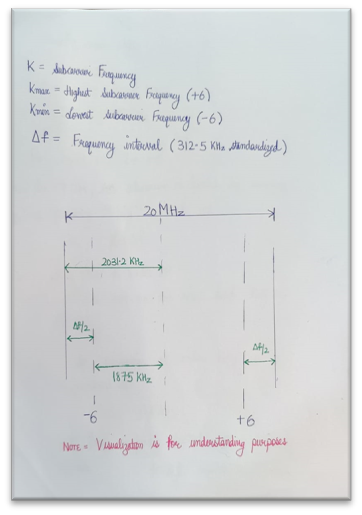
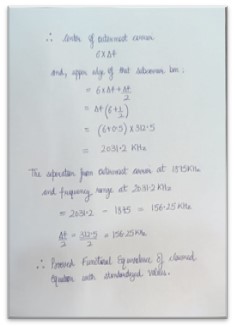
One recent case illustrates this precisely. A client posed a deceptively simple question: does a particular Wake-Up Receiver (WUR) patent read on IEEE 802.11-2024, and can it be monetised? The final claim limitation described a precise geometric relationship between subcarrier placement and channel edges, something the standard did not state in plain language.
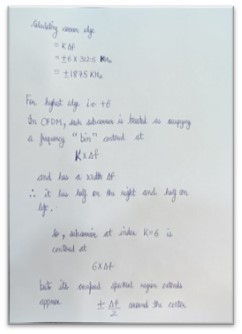
Working through the MC-OOK parameters from Clause 30 of the standard, outermost subcarriers at k = ±6, subcarrier spacing of 312.5 kHz. AI helped our analyst compute the geometric relationship: the gap between the outermost subcarrier and the channel edge equals exactly half the subcarrier interval, satisfying the claim limitation mathematically. SEP status was confirmed. Licensing, monetisation, and litigation pathways were unlocked.
6. Training, Onboarding, and the PSA Stage
AI has also transformed how we develop analyst capability:
- Junior analysts can query AI on demand for explanations of complex telecom equations, BRI concepts, and claim terminology, accelerating ramp-up time significantly.
- During the Patent Scope Analysis (PSA) stage, AI identifies functional equivalences between telecom-focused patents and their Wi-Fi context counterparts, ensuring every functional aspect of each claim is covered before the project goes to a client.
The practical outcome is a more consistent baseline of technical understanding across the team, and reduced dependency on senior analysts for routine conceptual questions.
The Governance Layer: Confidentiality Is Non-Negotiable
Embedding AI into client work creates an obligation that cannot be an afterthought: protecting the confidentiality of client data. Our protocol is unambiguous:
- Patent numbers, claim charts, client names, licensing strategy, and any commercially sensitive material are never entered into public AI tools.
- Only anonymized or publicly available technical data is used in AI interactions.
- Only organization-approved platforms are permitted. Consumer AI tools with data retention policies are prohibited for all client-related work.
- Every AI output is reviewed and validated by a qualified analyst before inclusion in any deliverable, no exception.
This is not a compliance checkbox. It is the foundation of trust with every client we serve.
What This Means for IP Strategy
The firms and legal teams that will lead IP monetization over the next decade are not the ones with the most patents or the biggest litigation budgets. They are the ones with the best intelligence, assembled faster, validated more rigorously, and presented with the mathematical precision that modern licensing and litigation demand.
AI, deployed strategically and governed responsibly, is the mechanism that enables that intelligence at scale. At Intellect Partners, we have seen first-hand what happens when expert judgment and AI capability are combined: throughput triples, accuracy improves, and the quality of analysis delivered to clients rises to a standard that was simply not achievable before. The ceiling did not just crack. For the firms willing to rebuild their workflow around this reality, it has been removed.