

Intellect-Partners

Categories
Others

When the Standard Goes Silent, the Math Must Speak to Prove Essentiality

When assessing a patent for its Standard Essential Patent (SEP) potential, the real challenge often lies not in whether the technology is relevant but in proving it, rigorously and clause by clause, against a living standard document. Most patents appear to map cleanly at first glance. The difficulty emerges when claim language carries abstract mathematical constructs, frequency-domain descriptions, and signal-processing logic that must be traced to specific normative text in the standard.

A recent Wi-Fi SEP evaluation project focused on US 12XXXX75, a patent covering a method for a wake-up receiver (WUR). It began with a deceptively simple question from the client:

“Does this patent read on the IEEE 802.11-2024 standard and can it be monetized?”

On the surface, the patent’s claims described a method for receiving a wake-up signal (WUS) over a frequency range, filtering it through a channel-selective filter, and modulating the signal on two or more equidistantly spaced carrier frequencies. These are real and specific engineering choices. But the challenge was proving, mathematically and normatively, that every element of the independent claim found its exact counterpart in the IEEE 802.11-2024 standard including one particularly intricate geometric relationship buried in the final claim limitation.

The preliminary read of the patent was encouraging. The independent claim describes a method for a WUR that:
  1. Receives a wake-up signal (WUS) over a frequency range with a signal bandwidth
  2. Filters the received WUS through a filter with a defined filter bandwidth
  3. Modulates the digital WUS sequence on two or more equidistantly spaced carrier frequencies
  4. Requires that the lowest and highest carrier frequencies are each separated from the respective edge of the frequency range by half the carrier frequency interval

The IEEE 802.11-2024 standard’s Section 30 Wake-Up Radio (WUR) PHY specification defines precisely this type of receiver-side operation. The WUR PHY uses multicarrier on-off keying (MC-OOK) to transmit and receive WUR signals within a 20 MHz operating channel, using a specific set of equidistant subcarriers. The alignment was strong but incomplete without resolving the final limitation.

The limitation is where the mapping became technically demanding. The claim requires that:

“…a lowest one of the carrier frequencies and a highest one of the carrier frequencies of the … from a respective edge of the frequency range.”

This is not a qualitative description. It is a quantitative geometric claim about the placement of the outermost active subcarriers relative to the edges of the transmission channel. Proving it required going beyond the normative text and solving the underlying signal-processing mathematics directly from the standard’s parameters.

Working Through the Mathematics

The IEEE 802.11-2024 standard defines the following parameters for MC-OOK transmission:

  • Active subcarrier indices: k = (−6, −4, −2, 2, 4, 6)
  • Subcarrier spacing: Δf = 312.5 kHz
  • IDFT size: 64-point, sampled at 20 MHz
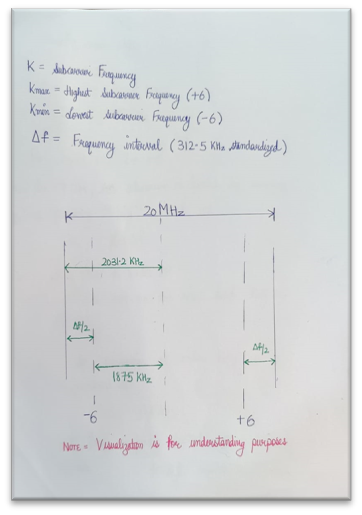
The outermost active subcarriers sit at k = ±6. Their frequency offsets from the channel center are:

f_outer = ±6 × 312.5 kHz = ±1875 kHz

Now, where is the “edge of the frequency range”? In OFDM-based systems, the edge of the frequency range defined by the subcarrier grid is conventionally placed at half a subcarrier spacing beyond the outermost subcarrier that is, at (k_max + 0.5) × Δf:

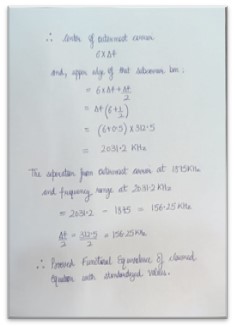
f_edge = (6 + 0.5) × 312.5 kHz = 6.5 × 312.5 kHz = ±2031.25 kHz

The separation between the outermost active carrier and the edge of the frequency range is therefore:

f_edge − f_outer = 2031.25 kHz − 1875 kHz = 156.25 kHz

And half the carrier frequency interval (Δf/2) is:

312.5 kHz / 2 = 156.25 kHz

The two values are identical. The lowest and highest active carrier frequencies are each separated from the respective edge of the 20 MHz frequency range by exactly half the subcarrier spacing of 312.5 kHz, confirming the claimed relationship.
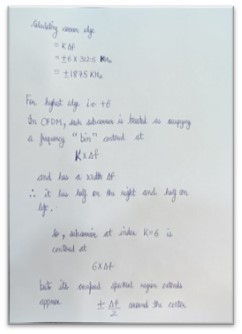
This was the breakthrough. The claim’s final limitation, which appeared abstract, is in fact a direct mathematical consequence of the MC-OOK subcarrier placement defined in IEEE 802.11-2024 Clause 30.

With the SEP status established including the resolution of the challenging final limitation the analysis unlocked several downstream opportunities for the patent owner:

  • Licensing leverage. The confirmed mapping to IEEE 802.11-2024 provides a concrete, defensible basis for licensing discussions with device manufacturers implementing Wi-Fi 6/6E WUR functionality. Any chipset or device that supports the WUR PHY as defined in 802.11-2024 Clause 30 is a potential licensing target.
  • Portfolio positioning. Wi-Fi 6 and Wi-Fi 6E deployments have accelerated significantly across consumer electronics, IoT devices, enterprise networking, and automotive applications. WUR, specifically, addresses the low-power connectivity use case central to battery-powered IoT. A confirmed SEP in this space carries real commercial weight.
  • Prosecution and portfolio strategy. The mathematical derivation work produced during the mapping exercise particularly the subcarrier edge-separation proof can inform continuation filings or claim amendments that more explicitly recite the standard-compliant parameters, potentially strengthening the patent family’s licensing position further.

The Wi-Fi 6 WUR mapping project is a good illustration of what rigorous SEP analysis looks like when the standard doesn’t hand you the answer directly. The technology was clearly aligned. The standard was clearly relevant. But the final link a specific, quantitative geometric relationship between subcarrier placement and channel edges required working through the mathematics of the OFDM subcarrier grid from first principles.

That is the work. And it is the work that determines whether a patent remains a theoretical asset or becomes an actionable one.


Categories
Others

The Process Of Declaring A Standard Essential Patent (SEP)

Standards and SEPs, what are they?

A standard is a set of technological advances, norms, or protocols utilized in like manner by different manufacturers or service providers while designing specified methods or products. Standards are fundamental for the worldwide reception of innovations and processes. For instance, different telecom advances, for example, Bluetooth and Wi-Fi capabilities comparatively on phones made by various organizations. The organizations, groups, or bodies that define and set standards are known as Standard Setting Associations (SSOs). The Alliance for Telecommunications Industry Solutions (ATIS) in the US, the European Telecommunications Standards Institute (ETSI) in Europe and The Association of Radio Industries and Businesses (ARIB) in Japan are some examples of SSOs working in the telecom sector.

While explaining a standard, a few innovations or processes might exist that some innovator has proactively patented, and without utilizing these patents, executing the standard is incomprehensible. Those patents crucial for executing a standard and have been acknowledged by the concerned SSO are known as Standard Essential Patents (SEPs). The role of SEPs is most critical in the field of telecommunications because with each new age, for example, 3G, 4G, and 5G, there are various standards defined by SSOs like ETSI. It is inordinately impossible to manufacture a telecommunication framework connected with the concerned standard without utilizing the advancements defined by SEPs.

Presently, organizations that make products that are per a standard need to have a permit of the relevant SEPs from the proprietors of the SEPs. The proprietors of the SEPs invest money, time, and different resources while inventing and defining their patented advances, and they ought to get reasonable royalties for their endeavors. Consequently, the SEPs are for the most part licensed on FRAND (Fair Reasonable, and Non-Discriminatory) terms. FRAND terms are an agreement between the SEPs holders and SSOs to give a SEP license to the standard implementers based on fair and reasonable conditions for both of the parties. FRAND is a voluntary agreement, and there is no implementing body to uphold the FRAND terms. If there is any conflict between the two parties on FRAND, the dispute can be put under the watchful eye of the concerned court, where the jury or judge will determine the issue.

Patent Designation as SEP

A patent is pronounced crucial for implementing a standard, ordinarily by the SSOs. While creating and defining a standard, the individuals from the SSO check for the potential patents which might be expected for the implementation of the standard as well as the patent proprietors pronounce to the concerned SSO that their protected innovation is fundamental to implementing the standard. After getting the rundown of such patents, the concerned SSO individuals check whether the unveiled patented innovation is utilized in the standard and further, assuming asked by the SSO’s higher authorities, an effort is made by the SSO members to track down alternative innovation solutions to find whether executing the standard without utilizing the corresponding patent. On the off chance that there is no other alternative, the patent is announced as essential for the specific standard, and the higher authorities of the SSO are informed about it.

License Granting According to the FRAND Terms

For the most part, in the wake of perceiving a patent to be fundamental for the standard implementation, the patent proprietor is requested by the concerned SSO, for example, ETSI to give an irreversible undertaking in a particular timeframe regarding its agreement to grant the license based on FRAND terms, however, the patent proprietor will undoubtedly give the license based on FRAND terms. If the patent proprietor doesn’t show interest in granting a license based on FRAND conditions, subsequent requests are made by the higher authorities of the SSO, for example, the Director-General on account of ETSI to get the license.

In any case, if the patent proprietor refuses to provide the license based on FRAND terms, the SSO decides whether the development of the concerned part of the standard ought to proceed or not. Notwithstanding, much of the time, the patent proprietors are the organizations that are members of the concerned SSO and play a part in developing the standard. These organizations ordinarily consent to give the license to their patented innovation based on FRAND terms. In many cases, the member organizations purposefully embed their patented innovations into various parts of the standard to profit from the FRAND terms’ royalties, which is an unethical activity.

Declaration of SEP

The SSOs by and large provide platforms on which the patent proprietors can declare assuming that they observe that a specific standard is utilizing their patented innovation. The patent holders need to give all the information concerning their patents utilized in the standard and the part of the standard that utilizes the concerning innovation. For instance, ETSI gives an “IPR Information and Licensing Declaration” platform. The declarants can open a submitter account on this platform and proclaim that their patented innovation is fundamental for executing a specific standard. The declarants can choose the specific part of the standard that is utilizing their innovation.

How to Find Declared SEPs

The proclaimed SEPs are generally revealed publicly by the concerned SSO. The information in regards to SEPs related to a specific standard/innovation and/or the SEPs connected with a specific assignee can be tracked down on the site of the concerned SSO.

For instance, ETSI gives an “ETSI IPR Online Database” as displayed in Fig. 3. The SEPs connected with a specific project, standard, as well as a declaring organization can be found by filling in the suitable details in the web-based data set of ETSI.

Conclusion

Standards play a significant part, particularly in telecom, to keep up with consistency in the work process of different advancements. With the approach of the new-gen, different new standards should be characterized. Frequently, these standards involve patented advances, without which implementing the standard is unthinkable. These patents are pronounced as SEPs by the SSOs. The proprietors of these patented innovations had invested a lot of effort while inventing these advances; consequently, they ought to be compensated reasonably. The most common way of setting standards, proclaiming SEPs, getting SEP licenses based on FRAND terms, and giving public info in regards to SEPs connected with standards is by and large controlled and implemented by SSOs.